Switching Dev Partners? What a Code Audit Must Reveal: What This Guide Covers
Published: October 12, 2026 · Last updated: October 12, 2026
You are about to hand a live product to a new team. The old team wrote every line, holds half the passwords, and has every reason to call the handover easy. Whatever the audit does not reveal now, you pay for later.
Switching dev partners without an independent code audit means signing for software nobody has read. A real audit must reveal five things: who owns the code and accounts, whether a new team can build and ship it, how sound the architecture is, what security and dependency risk it carries, and what fixing it will cost.
This guide is for founders, CTOs and product leaders at SaaS, health tech and fintech companies who are replacing an outside development team and need to know exactly what they are inheriting. It covers twelve checks, the red flags behind each one, and how to turn findings into a priced plan.
Handover meetings follow a pattern. The outgoing team says the code is clean. The incoming team says it is salvageable. Neither has run a scan. An audit replaces both opinions with a report.
Why Does Switching Dev Partners Demand an Independent Code Audit?
A code audit is an independent, written review of source code, configuration and infrastructure at one frozen commit, with findings ranked by severity and a plan to fix them. Switching dev partners demands one because you are about to take ownership of work you did not write, cannot fully see, and cannot easily undo.
Nobody buys a house on the seller's word that the foundation is fine. Software deserves the same inspection.
The scale of the problem is documented. The Consortium for Information and Software Quality (CISQ) estimated that poor software quality cost the US at least $2.41 trillion in 2022, and that accumulated technical debt reached roughly $1.52 trillion. CISQ also named technical debt the biggest obstacle to making changes to existing codebases. See the figures in the CISQ 2022 report.
Teams also confuse an audit with two neighbours. They are different tools, and buying the wrong one wastes money.
| Method | What it examines | Who runs it | What you get |
|---|---|---|---|
| Code review | Changes in a pull request, one at a time | The team that wrote the code | Safer merges, but no independence |
| Penetration test | The running system, attacked from outside. Source is not read | Security testers | Proof that specific flaws are exploitable |
| Code audit | Source, configuration and pipeline, read independently | An outside engineer | A ranked, priced report a stranger can trust |
They stack rather than substitute. A pen test cannot tell you the build fails on a clean machine. A code review cannot tell you the reviewer is also the author. Next question: when do you run the audit?
When Should You Run the Audit: Before You Leave, Before You Hire, or at Hand-Off?
Run the first audit before you tell your current partner you are leaving, run an independent takeover audit before you sign with the next one, and verify the hand-off once the transfer happens. Each moment answers a different question, and skipping the first is the most common and most expensive mistake.
Picture the call where you tell your agency you are leaving. Now picture learning on that call that they host the repository.
Before you leave: the quiet audit
Confirm you can reach the repository, cloud accounts and deployment pipeline with credentials you control. Access and a clean build tell you how hard the exit will be while the relationship is still intact.
Before you hire: the takeover audit
An independent team reads the code, scores the risk and prices the work. Your next partner should not quote blind, and you should not accept a quote written without reading the code.
At hand-off: the verification
Rotate every credential, confirm the repository and documentation arrived, and check that the new team can ship a change on day one.
Whatever the timing, freeze the codebase first. Tag a release or pin a branch before any tool runs so every finding traces to one commit. Findings against a moving target are arguments, not evidence.
Independence matters as much as timing. A partner auditing its own work has a conflict of interest, and so does a vendor grading the code of the firm it hopes to replace. Scope the audit as its own engagement, separate from any build quote. First finding to check: do you own what you are paying for?
Do You Actually Own Your Code and Accounts?
Code ownership means you hold admin control of the repository, cloud accounts, domains, app store listings and secrets, plus the legal right to use and change the code. An audit must confirm both the technical control and the paper trail first, because every later check depends on them.
Ownership is not what your contract says. It is what you can log into on a Monday morning.
| Asset | What to confirm | Red flag |
|---|---|---|
| Source repository | Your organisation owns it, you hold admin rights, and full commit history is intact | The repo sits in the vendor's account and you have read-only access |
| Cloud accounts | Billing and root access are in your name, with multi-factor authentication | Servers run inside the vendor's own cloud account |
| Domain and DNS | Registrar and DNS records are in your name | The vendor registered the domain as the owner |
| App store listings | Developer accounts belong to your company | Apps are published under the agency's developer account |
| Secrets and keys | You can list and rotate every API key, token and certificate | Nobody can say which keys exist |
| Licences and IP | Written IP assignment and a clear list of third-party licences | The contract is silent, or licences were never tracked |
Check the commit history too. A repository with a handful of squashed commits can mean history was wiped before handover, and the log is how a new team learns why things were built the way they were.
One caution. Ownership of commissioned software depends on your contract and local law, so ask your own legal counsel to review the assignment language. The audit shows you what exists. It does not replace legal advice. Once you hold the keys, the next test is whether anyone else can turn them.
Can a New Team Build, Run and Deploy It Without Calling the Old One?
A codebase is transferable when a new engineer can clone it, build it, run the tests and deploy to a staging environment using only the repository and its documentation. If any step needs the old team's help, that dependency is a finding, and the audit should price the cost of removing it.
Call it the clean-machine test. It takes an afternoon and ends more arguments than any status report.
Give the test to someone who has never seen the project. Familiarity hides gaps. Then look at what the failures have in common:
- Documentation. A README with setup steps, architecture notes and a list of environment variables. Missing documentation is a finding in its own right.
- Environments. Separate development, staging and production, with configuration kept out of the code.
- Pipeline. Automated build and deploy defined as code, not a script that lives on one laptop.
- Knowledge concentration. If one person has run every deploy, that is a single point of failure. Ask who it is and what happens when they leave.
A project that passes this test can change hands in days. One that fails it can still be rescued, but the failure tells you what the transition will really cost. Next layer down: the architecture itself.
Is the Architecture Something You Can Build On?
Sound architecture means clear module boundaries, a data model that fits the business, and infrastructure that can scale without a rewrite. An audit judges it by asking how expensive the next ten features will be, not whether the diagram looks tidy.
Bad architecture is rarely loud. It shows up as the quote that triples when you ask for something that sounded small.
- Boundaries. Can one part change without breaking five others? Tangled modules turn every feature into a risk.
- Data model. Does the schema reflect how the business works today, and can it grow? A weak schema is the costliest layer to fix.
- Scaling limits. Where does the system slow down, and what does it cost to move that limit? Ask for evidence, not reassurance.
- Lock-in. Proprietary frameworks, libraries written by the vendor, and hosting that cannot be left without a rebuild all belong in the report as dependency risk.
Architectural decay is the hardest finding to size. Decisions made years ago harden into constraints nobody can reverse cheaply. If the audit points to age rather than sloppiness, the legacy modernization trends for 2026 show when modernising a system beats replacing it. Security is the next dimension, and it has a fresh yardstick.
How Secure Is the Inherited Code? What OWASP Top 10:2025 Means for Your Audit
A security review of inherited code checks the source against the current OWASP Top 10, scans git history for leaked secrets, and confirms the compliance rules you operate under (GDPR, HIPAA, PCI DSS) are actually implemented. Grade against the 2025 edition, not the 2021 one.
Broken access control still holds the number one spot, and the 2025 data found it in an average of 3.73% of the applications tested.
The OWASP Top 10:2025 is the eighth edition of the list. It introduces Software Supply Chain Failures at number three and a new category for mishandled exceptional conditions. Here is how those categories translate into inherited-code checks:
| OWASP 2025 category | What to check in inherited code |
|---|---|
| A01 Broken Access Control | Endpoints with no authorisation check, users able to read each other's records, missing row-level rules |
| A03 Software Supply Chain Failures | Dependency versions left to float, unreviewed build steps, third-party CI actions nobody vetted |
| A07 Authentication Failures | Home-built login, weak session handling, no multi-factor authentication on admin accounts |
| A09 Security Logging and Alerting Failures | Logs nobody reads, no alerts on failed logins or server errors |
| A10 Mishandling of Exceptional Conditions | Errors that fail open, leak internals, or leave transactions half-finished |
“Great logging with no alerting is of minimal value in identifying security incidents.” The OWASP Top 10:2025 team, on why the category now says alerting.
Scan the full git history for hardcoded passwords, API keys and tokens, using tools such as gitleaks or TruffleHog. A key deleted from the latest commit still lives in history. Compliance runs on a separate track. GDPR asks how consent is recorded and whether erasure works. HIPAA asks about encryption, access control and audit logging. PCI DSS governs how card data moves and where it is stored. Confirm the details with your own compliance team.
Scanners find patterns. They miss business-logic gaps, which is why a manual read and, for high-risk products, security testing for web applications belong together. Next: the code you never wrote at all.
What Is Hiding in the Dependency Tree?
A dependency audit maps every direct and transitive package in the codebase, checks each for known vulnerabilities, licence conflicts and abandonment, and records the result in a software bill of materials (SBOM). A software bill of materials is a machine-readable list of every component, library and module inside a software product. Transitive dependencies are the ones nobody on your team chose.
The packages your developers picked are the visible tip. Each one pulled in others that nobody reviewed.
Veracode's 2026 research adds that third-party code drives the worst of it. The half-life of a third-party flaw is 358 days, against 243 days across all scan types. The full set of figures is in the Veracode 2026 State of Software Security summary.
The incidents are real. CISA's alert on CVE-2025-30066 describes a popular GitHub Action that was compromised and could expose secrets such as access keys, tokens and private keys from pipelines that trusted it. CISA later added it to its Known Exploited Vulnerabilities Catalog. Read the CISA alert and then ask which third-party actions and packages your pipeline trusts, and whether their versions are pinned.
- Vulnerabilities. Known flaws in direct and transitive packages, ranked by severity and exploitability.
- Licences. A copyleft licence buried in a transitive package can attach obligations to your own code. Surface it before you own the repository.
- Abandonment. Packages with no maintainer or release in years are future incidents.
- Reach. A package behind a clean boundary can be swapped in a day. One woven through every feature is a partial rewrite.
Continuous scanning in the pipeline is what DevSecOps managed security services automate, so the SBOM stays accurate after the audit ends. Now check whether anything protects the code from the next change.
Are There Tests, a Release Process and Monitoring, or Just Hope?
Release discipline is the set of automated tests, deployment pipelines and monitoring that lets a team change software without breaking it. An audit measures it through test coverage, pipeline automation, error tracking and the technical debt those gaps create. Technical debt is the accumulated cost of shortcuts and deferred fixes, expressed as the rework needed to make code maintainable again.
It is Friday, 4:50 pm. Checkout breaks. The first person to find out is a customer.
- Test coverage. Unit, integration and end-to-end tests, with the payment, login and data-export paths covered first.
- Pipeline automation. How much of the build, test and deploy runs without a human clicking through steps.
- Error handling and monitoring. Does the system tell anyone when it breaks, or does the customer find out first?
- Consistency. Divergent patterns across the codebase show that several people or eras touched it without a shared standard.
- Contracts. Missing data types and undocumented assumptions between modules live in someone's head, and that head is leaving.
Static analysis tools such as SonarQube report a technical debt ratio, which compares the effort to fix issues against the effort to build the code. Treat the number as a negotiating input, not a verdict. It gives both sides a shared language for pricing the cleanup.
If the audit shows thin testing, close that gap before the new partner starts shipping. A QA and testing services engagement builds the safety net first, so the first release under new ownership is boring in the best way. Some of the thinnest safety nets belong to products built very fast.
Is It a Production System or a Prototype in a Production Costume?
A prototype in a production costume is software that works in a demo but lacks the authentication, data protection, environments and monitoring a live product needs. AI coding tools and rushed agency builds both produce it, and a code audit is how you tell the difference before you pay for it.
Fast to build and safe to run are different properties. Plenty of products have only the first.
Veracode's Spring 2026 GenAI Code Security report found that AI-generated code introduces security flaws that need the same detection and fixing as any other code. The source of the code does not change the risk. Look for the findings that recur in fast-built products:
- Missing authentication. API endpoints that answer anyone who asks.
- No input validation. The gap behind SQL injection and cross-site scripting.
- No row-level security. One user's query can surface another user's records.
- Secrets in code. Keys committed to the repository and never rotated.
- Platform lock-in. Hosting or a database that sits inside a builder platform, where leaving means a rebuild rather than a migration.
Production-readiness has a short list: separate test and live environments, automated releases, error monitoring, correctly built authentication and authorisation, and a schema designed for growth. Our guide to the vibe coding problems that break production walks through the failure patterns in detail.
If the product includes AI features, audit the model integration too, not only the app around it. Slapping an AI wrapper on an app does not fix scaling problems. Machine learning has to talk to your real data, and that is the work behind custom AI development services built for production rather than demos. The audit's job is to draw a line: this part needs remediation, this part needs replacing.
How Do You Read an Audit Report and Decide: Keep, Fix or Replace?
A useful audit report ranks every finding by severity, attaches steps to reproduce it, estimates the effort to fix it, and recommends whether each area should be kept, fixed or replaced. A report without effort estimates is an opinion, not a plan.
So what do you do with a hundred-page PDF? You make it answer one question: what do we do on Monday?
| Finding | Suggested priority | Usual decision |
|---|---|---|
| Missing authentication on live endpoints | Critical | Fix before the transfer completes |
| Secrets in git history | Critical | Rotate now, then clean the history |
| Licence conflict in a core dependency | High | Replace it or get legal sign-off |
| No tests on the payment flow | High | Add tests before new features |
| Architecture that blocks scaling | Varies | Plan a staged rewrite of that module only |
| Inconsistent naming and style | Low | Fix gradually as code is touched |
Use the report as negotiating power. Ask the outgoing partner to fix critical findings under the existing contract before the transfer, and tie the new partner's payments to findings closed. Evidence makes both conversations shorter.
Before you commission an audit, ask for a fixed scope, a written timeline and a sample report. Time and price follow code size, the number of services and how much documentation exists. Anyone who quotes without asking about those is guessing.
How TAK Devs Runs a Takeover Audit
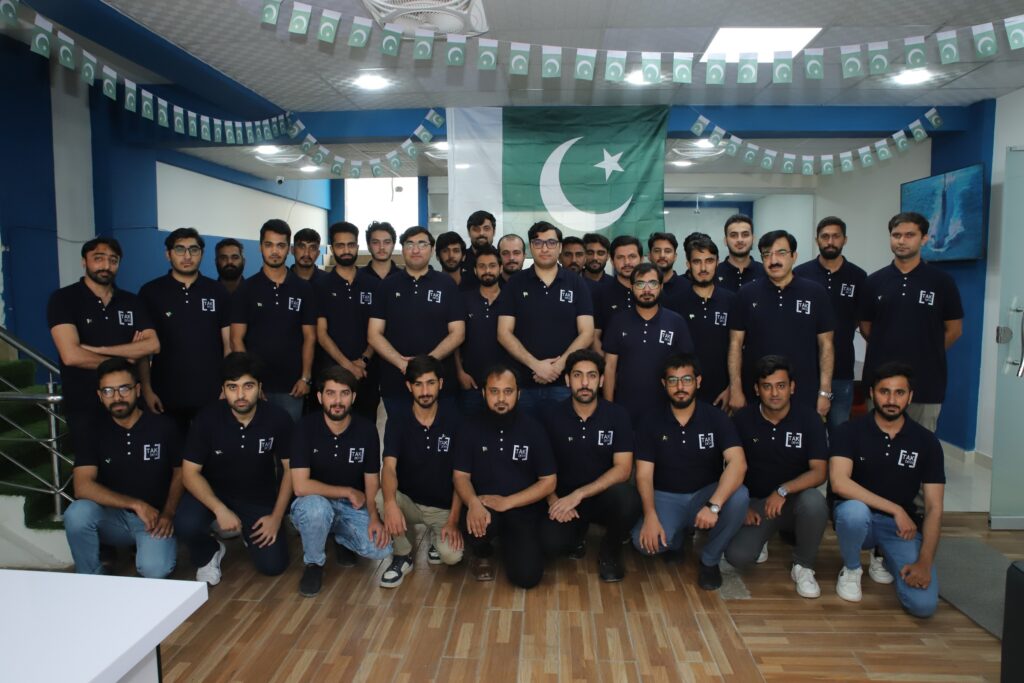
TAK Devs is a custom software and AI development company with an engineering team in Islamabad and a presence in the US, serving clients in the US and Europe. We have delivered 150+ projects, and we hold ISO 9001 (quality) and ISO 27001 (security) certifications. That mix matters here, because an audit is only as good as the quality and security discipline behind it.
Our practitioner view is simple: the audit must end in a decision, not a document. Here is the five-step shape we use for a takeover audit:
- Freeze and inventory. Pin one commit, list every repository, account, domain and key, and confirm who controls each.
- Run the clean-machine test. An engineer who has never seen the project clones, builds, tests and deploys using only what exists in the repository.
- Read and scan. Automated tools take the first pass. A senior engineer then reads the architecture, the security-critical paths and the dependency tree.
- Rank and price. Every finding gets a severity, steps to reproduce it and an effort estimate in days.
- Decide together. A working session turns the report into keep, fix or replace calls, with a sequenced plan.
TAK Devs point of view: scope the audit as its own engagement, separate from any build quote, so the report stays independent of what comes next.
We do not just write code. We take ownership of the whole project, from strategy and UI/UX through development, QA, cloud and maintenance, so the audit is the first step of a plan we are willing to be accountable for. If you want to see how we frame the work, read about our independent software audit services.
What Happens After the Audit? A 90-Day Transition Plan
After the audit, a clean transition runs in three phases: secure access and credentials first, fix critical findings next, then hand day-to-day delivery to the new team with documentation and monitoring in place. Ninety days is a realistic frame for most products, though the audit's effort estimates should set the real dates.
The audit is not the finish line. It is the last point at which the old team still has to cooperate.
| Phase | Focus | Done when |
|---|---|---|
| Days 1 to 30: Secure | Transfer repositories and accounts, rotate every key, freeze scope | Everything is under your control and nothing depends on the old team's logins |
| Days 31 to 60: Stabilise | Fix critical and high findings, add tests on critical paths | No critical finding is open and the pipeline runs green |
| Days 61 to 90: Deliver | New partner ships features through the pipeline | A release goes out without the old team involved |
Before the old team signs off, ask four questions: which areas are riskiest to change, which scheduled jobs and integrations exist, which third-party contracts renew soon, and who holds credentials today. Write the answers down. Tacit knowledge leaves with the people.
If the handover includes moving hosting or platforms, read the 2026 software migration playbook before you set dates. Once delivery is stable, keep the product healthy with software maintenance and support services so debt does not rebuild quietly. The full range of software, cloud, QA and security work sits under our TAK Devs solutions.
Switching dev partners is a business decision, and it deserves evidence. A code audit that reveals ownership, transferability, architecture, security, dependency risk and fix cost turns the switch from a leap into a plan.
Switching Dev Partners and Code Audits: Frequently Asked Questions
The questions founders and CTOs ask when the old team is on the way out and the new one has not started yet, answered straight.
Yes, if you can do it with access you already hold. A quiet audit of repository access, cloud accounts and the build process shows how hard the exit will be before the relationship changes. Do not request anything you are not entitled to, and do not wait for the notice period to discover that the repository sits in the vendor's account.
It can document the system and answer questions, but it should not be your auditor. A partner reviewing its own work has a conflict of interest, and familiar reviewers miss structural problems they helped create. Use an independent third party for the audit, and treat the outgoing team's input as context, not a verdict.
Start with your contract. Check what it says about source code delivery and IP assignment, then ask in writing for repository, cloud and domain access. If they refuse, involve your lawyer before taking any action, because rights depend on the agreement and local law. A refusal is also a serious signal about what the handover will cost.
Time follows code size, number of services and documentation quality, not the auditor's calendar. A small, well-documented app moves fastest. A multi-service platform with no documentation takes longest. Ask for a fixed scope, a written timeline and a sample report before you commission the work, so nobody discovers the scope halfway through.
Often yes, because they answer different questions. A code audit reads the source and finds structural flaws, while a penetration test attacks the running system and proves which flaws are exploitable. For products that handle payments, health data or personal data, run both, with the audit first so testers know where to look.
It should inform the decision, not make it. A good report ranks findings by severity, estimates effort, and recommends keep, fix or replace for each area. Many products end up with targeted repair in some modules and replacement in a few. A full rewrite is a large bet, so ask for evidence that the architecture itself blocks the business first.
It depends on your jurisdiction and how the work was commissioned. In many places, copyright in custom software stays with the creator unless the contract assigns it in writing. Do not assume you own it. Ask your own legal counsel to review your agreement, and use the audit to document exactly what exists and which licences it relies on.
It needs the same audit with extra attention to known weak spots. Check authentication on every endpoint, input validation, database access rules, secrets in code and platform lock-in. Veracode's 2026 research found that AI-generated code carries security flaws needing the same fixes as human-written code, so apply the same severity ranking and the same fix standard.
Stop Switching Dev Partners Blind
If you are about to hand your product to a new team, start with evidence. Tell us what you are inheriting and we will scope an independent audit that ends in a ranked, priced plan.
Scope an Independent Software Audit