





What Do TAK Devs Modernization Services Cover?
Software modernization updates or replaces legacy software so it costs less to run, stays secure and changes faster. TAK Devs owns the whole job: assessment, cloud migration, breaking up monoliths, refactoring, DevSecOps and UI/UX. We work in phases, so your live system keeps running while the new one takes over. Hand us the whole system or one piece.
Waiting has a price. The US Government Accountability Office reports that federal agencies spend about 80 percent of their IT budgets on operating and maintaining existing systems (GAO-25-107795, July 2025). Every year a legacy system stays, it eats the budget meant for what comes next.
Modernization Assessment
Know what to fix before you spend a dollar building.
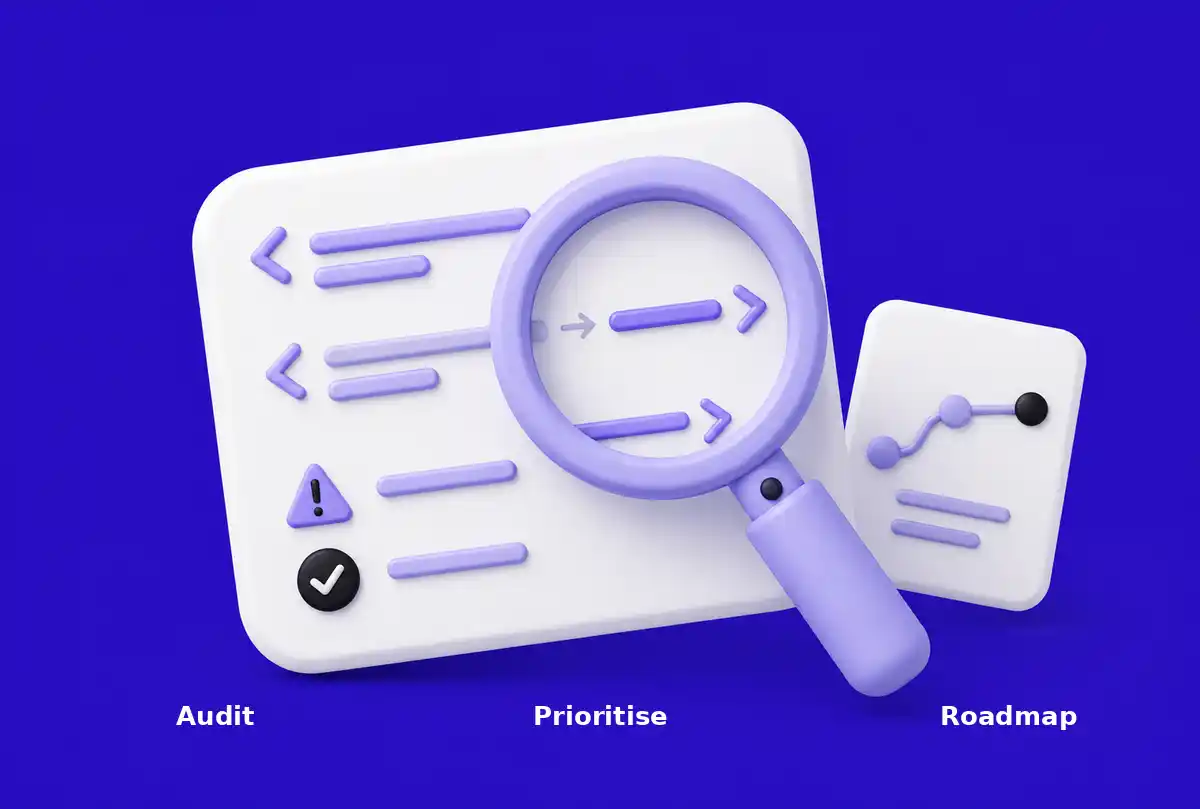
We audit your codebase, infrastructure, and dependencies, then hand you a prioritized roadmap that fits on one page.
- Full technical debt and dependency audit with a risk-ranked backlog.
- Cloud-readiness and rehost-versus-refactor recommendation for each component.
- A fixed-price scope for phase one, so there are no surprise invoices later.
- Clear go or no-go signal. If modernization is not worth it yet, we say so.
Cloud Migration
Move to AWS, Azure, or GCP without breaking production.
We replatform and re-architect legacy apps for the cloud, cutting infrastructure cost and unlocking elastic scale.
- Rehost, replatform, or full refactor, matched to your budget and timeline.
- Containerization with Docker and Kubernetes for portability across clouds.
- Typical 20-35% cloud cost reduction identified during migration planning.
- Zero-downtime cutover strategies so live operations keep running.
Building Scalable Microservices
Break the monolith apart without a full-year freeze.
We decompose tangled monoliths into modular services you can deploy, scale, and fix independently.
- Domain-driven service boundaries mapped to your actual business logic.
- Strangler-pattern migration so old and new run side by side during the transition.
- API-first design with clean contracts between services.
- Independent deployment, so one broken feature never takes down the whole app.
Application Re-Engineering
Rebuild the core logic that everything else depends on.
When a patch will not cut it, we re-engineer the application core for maintainability and performance.
- Replatform outdated frameworks to modern, supported stacks.
- Rewrite brittle business logic into testable, documented modules.
- Strategic reuse of components that still work, so you are not paying to rebuild the wheel.
- Performance gains that users feel, not just metrics on a dashboard.
Code Refactoring
Clean up the code your team is afraid to touch.
We refactor legacy code into a maintainable state, cutting the complexity that slows every future change.
- Automated and manual cleanup that reduces manual work and defect rates.
- Test coverage added around critical paths before we change anything.
- Modern framework upgrades (for example ASP.NET Core, current React, current Node).
- Documentation so the next developer is not reverse-engineering your app.
Infrastructure Modernization
Replace the aging plumbing under your applications.
We modernize the infrastructure layer so your apps run on fault-tolerant, observable, cost-efficient foundations.
- Infrastructure-as-code with Terraform or Pulumi for repeatable environments.
- Serverless and managed services where they lower cost and overhead.
- Fault recovery and zero-downtime update patterns for business continuity.
- Monitoring and observability so you catch problems before customers do.
DevSecOps Transformation
Ship faster and safer without picking one over the other.
We build CI/CD pipelines with security baked in, so speed and safety stop being a trade-off.
- Automated build, test, and deploy pipelines for faster release cycles.
- Security scanning and compliance checks embedded in the pipeline, not bolted on.
- Infrastructure and configuration managed as code and version-controlled.
- Rollback and blue-green deploys so a bad release is a non-event.
UI/UX Modernization
Make the interface match the decade you are in.
We redesign dated, clunky interfaces into responsive, accessible experiences your users actually enjoy.
- Responsive, mobile-first rebuilds of legacy web front ends.
- Accessibility and usability improvements, not just a coat of paint.
- Design systems so future screens stay consistent without redesign meetings.
Trusted and recognized across the industry





How TAK Devs Works
Process diagrams look the same at every agency. What matters is what actually happens inside each phase. Here is how we work in practice, refined across 150+ delivered projects.
- 150+ projects delivered
- ISO 9001 quality certified
- ISO 27001 security certified
Discovery Call
We uncover what you actually need first.
Output: problem briefScoping Workshop
Goals become a costed, prioritised delivery plan.
Output: scope and roadmapSprint Delivery
Tested, working software shipped every sprint.
Output: working softwareLaunch & Handoff
Live deployment, full docs, clean knowledge transfer.
Output: live product and docsOngoing Support
We monitor, maintain, and scale after launch.
Output: monitored and maintainedNot sure which phase you are in? Start with a discovery call and we will tell you honestly.
Book a discovery callIs your legacy system one bad release away from a bad week?
Start with an assessment and a fixed-price phase one.
No commitment. A 20-minute call.
Who We Work With
If any of these hits close to home, you are in the right place.
Founders
CTOs and VPs of Engineering
Ops Leaders
Product Managers
Industries We Serve
Domain context that keeps modernization from breaking your business rules.
Healthcare
HIPAA-aligned systems, patient data, and legacy clinical tooling.
Fintech
Secure data handling, audit trails, and high-reliability transactions.
Logistics
Real-time operations that cannot afford downtime during migration.
Retail and eCommerce
Scalable platforms built for traffic spikes and fast iteration.
EdTech
Modernizing dated learning platforms for scale and accessibility.
Manufacturing
Connecting legacy systems to modern data and automation workflows.
Rehost, Replatform, Refactor or Rebuild: Which Fits?
There is no single right answer for a whole system. The right move differs per component, and the lightest change that fixes the real problem usually wins.
| Approach | What changes | Pick it when | Watch out for |
|---|---|---|---|
| Rehost | The app moves to cloud infrastructure with no code changes (lift and shift). | The code works and you need off aging hardware or a data center fast. | Old problems move with you. Costs can rise if nothing is tuned after the move. |
| Replatform | The app moves to a new runtime or managed service with minimal code changes. | You want managed databases or platform services without a rewrite. | Small code changes still need full regression testing. |
| Refactor | The code changes without changing what users see. | The app works, but every change is slow, risky or expensive. | Add test coverage first, or you trade old bugs for new ones. |
| Rebuild | You start over on a modern architecture. | The architecture blocks growth and refactoring costs more than it returns. | The longest path. Phase it, or the business waits too long for value. |
| Retain or retire | You keep the system as it is, or switch it off. | It is stable and low value to change, or nobody uses it anymore. | A retained system still needs patching and an exit date. |
Approach definitions follow Microsoft's 6 Rs of application modernization (Microsoft Learn, updated May 19, 2025). Our modernization assessment recommends one approach per component.
Why Do Teams Pick TAK Devs to Modernize?
Fixed-Price Scoping
Honest scoping and fixed-price options on defined work. No surprise invoices, no 80-page proposals nobody reads.
Modernization Without Disruption
Phased, low-risk migration with zero-downtime cutover so live operations never stop.
Production-Grade By Default
We build for real users and real load, not demo-day theatre. Notebooks are for prototypes.
Code You Own
No licensing traps, no vendor lock-in. The code and the data are your asset, not ours.
What Working With TAK Devs Actually Looks Like
In early 2025, UpliftCare came to us with a clear challenge and a tight window. They needed a complete, HIPAA-aligned telehealth marketplace connecting patients, verified therapists, and healthcare institutions. The deadline was three months, set by an investor presentation they could not move.
There was no technical architecture. No defined roadmap. Just a vision and a date.
TAK Devs took on the full product lifecycle.
In six sprints and twelve weeks, we delivered:
Four connected portals covering Patient, Therapist, Admin, and Institutional workflows
Real-time video consultations via WebRTC, integrated Stripe payments, and smart scheduling
HIPAA-aligned architecture with full encryption across all data flows
Automated credential verification that reduced therapist onboarding time by 70%
CI/CD pipelines, automated testing, and AWS-based deployment ready for production from day one
What Clients Say About Working With TAK Devs
I'm happy with TAK Devs Pvt Ltd's work quality. Our engagement with TAK Devs Pvt Ltd is a huge success. Our project is very complex and has many engineering metrics and variables, and the team delivers high-quality work.

TAK Devs Pvt Ltd delivered a robust system designed to handle 2 million daily users, achieving a seamless integration of PDF creation as part of the authentication process. The team consistently met deadlines and was highly responsive, flexible, transparent, understanding, and proactive.

Thanks to TAK Devs Pvt Ltd, the client can seamlessly track session duration, user engagement, and login metrics. They also can efficiently monitor appointment bookings, assess client-therapist match rates, and collect feedback. The service provider's knowledge and quality delivery are exemplary.

TAK Devs Pvt Ltd delivered a functional POC and offered detailed guidance throughout the development process. The team was helpful in explaining the project's complexities for the client to understand everything thoroughly. They communicated via virtual meetings, email, and messages.

Great communication, top understanding of Spec, autonomous development. Everything Perfect.

Real professionists, always ready to help our resident team. It's a pleasure to work with them.

Great work, implemented everything 100% as per our specifications, and very fast!

TAK Devs Pvt Ltd's efforts have been met with positive acclaim. The team is always available and communicative via virtual meetings and email. Their software development expertise and listening skills make them stand out.

Software Modernization FAQs
What are software modernization services?
Software modernization services update or replace legacy systems so they run on modern, scalable, secure architectures.
- Common work includes cloud migration, refactoring, and re-architecting monoliths into microservices.
- The goal is lower maintenance cost, better security, and readiness for AI and analytics.
How long does a modernization project take?
Most TAK Devs modernization engagements ship a first phase in around 12 weeks from brief to launch.
- Timeline depends on system size, technical debt, and how many components move at once.
- We phase the work so you see a working result early instead of waiting a year.
Will modernization take my systems offline?
No. We use phased migration and zero-downtime cutover patterns so live operations keep running.
- Old and new systems run side by side during the transition using the strangler pattern.
- Cutover happens only once the new component is proven in production conditions.
How do I know if my software actually needs modernizing?
If maintenance keeps rising, changes take too long, or security and scaling are constant worries, it is usually time.
- Rising legacy maintenance costs and limited scalability are the clearest signals.
- Our assessment gives you an honest go or no-go answer before you commit to a build.
What if we start and realize it is not the right fit?
We scope work in phases with a clear checkpoint after phase one, so you can stop without sinking a full budget.
- There is no long-term lock-in in our standard contract.
- If another provider suits you better, we will point you to them.
What does pricing look like for modernization services?
We offer fixed-price scoping for defined phases, so you know the cost before work starts.
- Pricing depends on scope, system complexity, and the migration path you choose.
- No open-ended hourly meters and no surprise invoices at the end of a phase.
Do you offer staff augmentation or developers for hire?
No. TAK Devs scopes and delivers modernization as a project or engagement, not as rented headcount.
- You get an outcome and a working system, not seats on your payroll.
- If you need more capacity, we scope it as delivered work with clear deliverables.
Who owns the code and IP after the project?
You do. All code, infrastructure, and documentation are handed over to your team at the end.
- We build so your team can own and maintain the system without us.
- Clean documentation and CI/CD pipelines are part of the handoff.
How do you handle security and compliance during modernization?
We build security and compliance controls into the architecture from day one, not as an afterthought.
- Controls can be aligned to frameworks like HIPAA and GDPR where your data requires it.
- TAK Devs is ISO 27001 and ISO 9001 certified, and we delivered UpliftCare's HIPAA-aligned telehealth marketplace with encryption across all data flows.
What happens after launch?
We offer SLA-backed ongoing support and iteration for as long as you need it, with no forced retainer.
- You choose whether we stay on for maintenance or hand off entirely.
- Support is scoped transparently, like everything else.
Which modernization approach fits: rehost, refactor or rebuild?
Pick the lightest change that fixes the real problem.
- Rehost when the code works and you need off old hardware fast.
- Refactor when the code works but every change is slow and risky.
- Rebuild when the architecture itself blocks growth.
- Microsoft's 6 Rs guide uses the same logic. Our assessment names one option per component, not one for the whole system.