







What We Build
Speed is a revenue line, not a nice-to-have. Akamai’s 2017 State of Online Retail Performance research found that a 100-millisecond delay can cut conversion rates by 7%, and former Amazon engineer Greg Linden reported that every 100 ms of added latency cost Amazon roughly 1% of sales.
Our application performance optimization services cover the full stack, so the fix lands where the time is actually lost.
Find the Real Bottleneck
Performance audits and profiling that replace guesswork with evidence.
A performance audit is a structured assessment that measures how your software behaves under real load and pinpoints the specific code paths, queries, or services causing slowdowns. We profile before we recommend, because guessing which part of the code matters is the fastest way to waste a sprint.
- Baseline metrics across p50, p95, and p99 latency, throughput, error rates, and resource use
- CPU, memory, and I/O profiling to locate hot code paths and memory leaks
- Distributed tracing across microservices to find the one slow downstream call dragging everything else
- Real user monitoring alongside synthetic tests, so lab numbers match what customers experience
- A prioritized fix list ranked by business impact per engineering hour
Code That Stops Dragging
Application-level fixes for algorithms, memory, and inherited technical debt.
Code-level optimization improves how efficiently your application does its work, not how much hardware it runs on. It is often where the biggest wins hide, and usually the cheapest ones.
- Algorithm and data-structure fixes, such as replacing O(n²) loops with O(n log n) approaches on large datasets
- Asynchronous processing and message queues (RabbitMQ, Apache Kafka, Amazon SQS) to move slow work off the request path
- Memory-leak and garbage-collection tuning for Java, .NET, Node.js, Python, and Go services
- Targeted refactoring of hot paths, without a risky full rewrite
- Removal of redundant API calls, repeated computation, and chatty service-to-service traffic
Queries That Stop Crawling
Database tuning for apps held hostage by one slow query.
Database optimization is the process of making queries, indexes, and data access patterns faster and less resource-hungry. A single missing index can turn a millisecond lookup into a multi-second wait without any visible change in the query text.
- Execution plan analysis with EXPLAIN and EXPLAIN ANALYZE to see what the database actually does
- Index design for high-read columns, foreign keys, and time-based queries, without slowing writes
- Elimination of N+1 query patterns that turn one page load into hundreds of round trips
- Connection pooling (PgBouncer, HikariCP) to prevent connection exhaustion during traffic spikes
- Read replicas, partitioning, and sharding plans when a single instance hits its ceiling
- Tuning for PostgreSQL, MySQL, MongoDB, and SQL Server
Caching Without Stale Surprises
Multi-layer caching that speeds reads without serving yesterday’s prices.
Caching stores the results of expensive work so your system does not repeat it for every request. Done badly, it also stores yesterday’s prices and shows them to today’s customers.
- Browser and HTTP caching headers (Cache-Control, ETag) for static and semi-static assets
- CDN caching through Cloudflare, Amazon CloudFront, or Azure Front Door
- Distributed caches with Redis or Memcached for sessions, tokens, and hot query results
- Invalidation strategies designed up front (time-based TTL, event-driven purging, write-through)
- Cache hit-rate monitoring, so you know each cache layer is earning its memory
Frontends Users Don't Abandon
Core Web Vitals work that protects conversions and search rankings.
Frontend performance decides whether visitors wait or leave, and it is invisible to backend dashboards. Google’s research found that 53% of mobile site visits are abandoned when a page takes longer than three seconds to load.
- Core Web Vitals remediation against Google’s ‘good’ thresholds: LCP within 2.5 seconds, INP within 200 milliseconds, CLS below 0.1
- Critical rendering path fixes: inline critical CSS and defer non-essential JavaScript
- Code splitting, tree shaking, and route-based bundles so users download only what the current screen needs
- Image optimization with WebP and AVIF, responsive srcset, and lazy loading below the fold
- Third-party script audits (tag managers, chat widgets, trackers) that silently block interaction
Fast on Every Device
Mobile and cross-platform performance across iOS, Android, and browsers.
An app that flies on a flagship phone can crawl on a three-year-old Android over patchy 4G. We test and tune for the devices your users actually own, not the ones your developers carry.
- App startup time, rendering jank, and frame-drop fixes for native iOS, Android, React Native, and Flutter apps
- Network resilience through request batching, offline caching, and graceful handling of slow connections
- Battery and memory profiling to stop background processes draining devices
- Cross-browser and cross-device testing on real hardware, not just emulators
- App size reduction to cut install drop-off on low-storage devices
Load Tests Before Launch
Performance testing that finds breaking points before customers do.
Performance testing measures how software behaves under expected, peak, and extreme load. Real traffic does not care how well it went in staging.
- Load, stress, spike, and soak testing with k6, Apache JMeter, Gatling, and Locust
- Realistic traffic models built from your production patterns, not round-number guesses
- Automated plus manual testing: scripted suites for regressions, expert exploratory testing for edge cases
- Chaos experiments that simulate failed nodes, slow dependencies, and network loss
- CI/CD performance gates that fail the build when a latency budget is breached
Scale Without Bill Shock
Infrastructure tuning that handles traffic spikes without overprovisioning everything.
Throwing bigger servers at slow code is the most expensive way to stay slow. Flexera’s 2026 State of the Cloud Report puts estimated wasted cloud spend at 29%, the first increase in five years.
- Rightsizing compute, memory, and storage against measured usage, with 20-35% cloud cost reduction typically identified in TAK Devs reviews
- Autoscaling policies (AWS Auto Scaling, Kubernetes HPA and VPA) tuned to latency and queue depth, not just CPU
- Load balancing with NGINX, HAProxy, or cloud-native balancers to remove single points of failure
- Serverless tuning for cold starts, memory allocation, and concurrency limits
- Architecture patterns proven on systems built to handle 2M+ daily users
APIs That Answer Faster
Network and API design that stops shipping data nobody uses.
Many slow screens are really slow APIs, fetching full records to display three fields. We fix the shape of the conversation between services, not just its speed.
- HTTP/2 and HTTP/3 adoption for multiplexing and connection reuse
- Gzip or Brotli compression, plus Protocol Buffers for internal service traffic
- Pagination, field selection, and GraphQL query design to end over-fetching
- Keep-alive and outbound connection pooling to avoid repeated TCP and TLS handshakes
- API gateway and rate-limit tuning that protects the backend without throttling real users
AI Features Without Spinners
Latency and cost optimization for LLM and machine learning features.
Users now expect AI answers to start appearing almost instantly, and every token has a price. AI performance optimization reduces both the waiting time and the inference bill.
- Response streaming, so users see output while the model is still generating
- Semantic and prompt caching for repeated questions
- Model routing: smaller, faster models for simple requests, larger ones only when needed
- Vector database and retrieval tuning for RAG pipelines
- Batching, quantization, and GPU utilization reviews for self-hosted models
- Token budgets and cost dashboards per feature
Keep Fast Apps Fast
Monitoring and regression prevention after the optimization work ends.
Performance is not a one-time project, because every release, feature, and new data set can reintroduce slowness. We build guardrails so regressions get caught at the merge request, not in a customer complaint.
- APM setup and dashboards with Datadog, New Relic, Dynatrace, or Grafana and Prometheus
- Service level objectives (SLOs) tied to the user journeys that drive revenue
- Release-over-release benchmarking to catch regressions before full rollout
- Alerting tuned to real problems, so on-call engineers are not woken up for noise
- Distributed tracing with OpenTelemetry for faster root-cause analysis
When Tuning Isn't Enough
Modernization for legacy systems that have hit their architectural ceiling.
Sometimes the honest answer is that no amount of tuning will rescue a monolith built for a tenth of today’s traffic. We will tell you when that is the case, and what a staged modernization path looks like.
- Architecture reviews that separate tuning problems from structural ones
- Incremental extraction of high-load components into independently scalable services
- Platform rebuilds, such as the TAK Devs move of the Holiday Horse marketplace from Magento to microservices
- Cloud migrations with performance baselines captured before and after the move
- Staged rollouts with feature flags, so modernization never means a big-bang weekend
Trusted and recognized across the industry





How TAK Devs Works
Process diagrams look the same at every agency. What matters is what actually happens inside each phase. Here is how we work in practice, refined across 150+ delivered projects.
- 150+ projects delivered
- ISO 9001 quality certified
- ISO 27001 security certified
Discovery Call
We uncover what you actually need first.
Output: problem briefScoping Workshop
Goals become a costed, prioritised delivery plan.
Output: scope and roadmapSprint Delivery
Tested, working software shipped every sprint.
Output: working softwareLaunch & Handoff
Live deployment, full docs, clean knowledge transfer.
Output: live product and docsOngoing Support
We monitor, maintain, and scale after launch.
Output: monitored and maintainedNot sure which phase you are in? Start with a discovery call and we will tell you honestly.
Book a discovery callStruggling to keep up with development demands?
See how we can streamline your workflow.
No commitment required | Takes 20 minutes !

Who We Work With
Leaders who can already feel the slowdown in their numbers.
Startup Founders
CTOs and VPs of Engineering
E-commerce and Product Leaders
Ops and Finance Leaders
AI and Data Leads
Industries We Serve
Performance priorities change by industry, so our focus does too.
E-Commerce & Retail
Checkout speed, search latency, and flash-sale traffic spikes.
Fintech
Low-latency transactions, reporting queries, and secure caching of sensitive data.
Health Tech
Fast patient and provider portals that stay HIPAA-aligned.
SaaS
Multi-tenant database performance and noisy-neighbor isolation.
Travel & Hospitality
Availability search, booking engines, and seasonal peaks.
Legal Tech
Document search and large-file processing at scale.
Automotive & Mobility
Real-time telemetry, maps, and mobile app responsiveness.
Consulting Providers
Client portals and data-heavy dashboards.
Why Teams Pick TAK Devs
Measure Before Touching
Every engagement starts with a baseline, so improvements are proven with before and after numbers. No ‘it feels faster now’ reports.
Business Metrics, Not Vanity Scores
Fixes are prioritized by impact on conversion, retention, and cloud spend. A perfect Lighthouse score on a page nobody visits helps nobody.
QA-Grade Performance Testing
Performance testing sits inside our dedicated QA practice, combining automated suites with manual expert testing. Cross-platform coverage across devices, operating systems, and browsers.
Security Stays Intact
ISO 27001-certified processes mean speed never comes at the cost of data protection. Caching and CDN changes are reviewed for data exposure risk before release.
Fixed-Price Audit Scoping
Start with a fixed-price performance audit before committing to anything larger. No 80-page reports nobody reads: findings arrive as a ranked, costed fix list.
Handoff, Not Dependency
You keep the code, dashboards, tests, and documentation. No long-term lock-in contracts.
What Working With TAK Devs Actually Looks Like
In early 2025, UpliftCare came to us with a clear challenge and a tight window. They needed a complete, HIPAA-compliant telehealth marketplace connecting patients, verified therapists, and healthcare institutions. The deadline was three months, set by an investor presentation they could not move.
There was no technical architecture. No defined roadmap. Just a vision and a date.
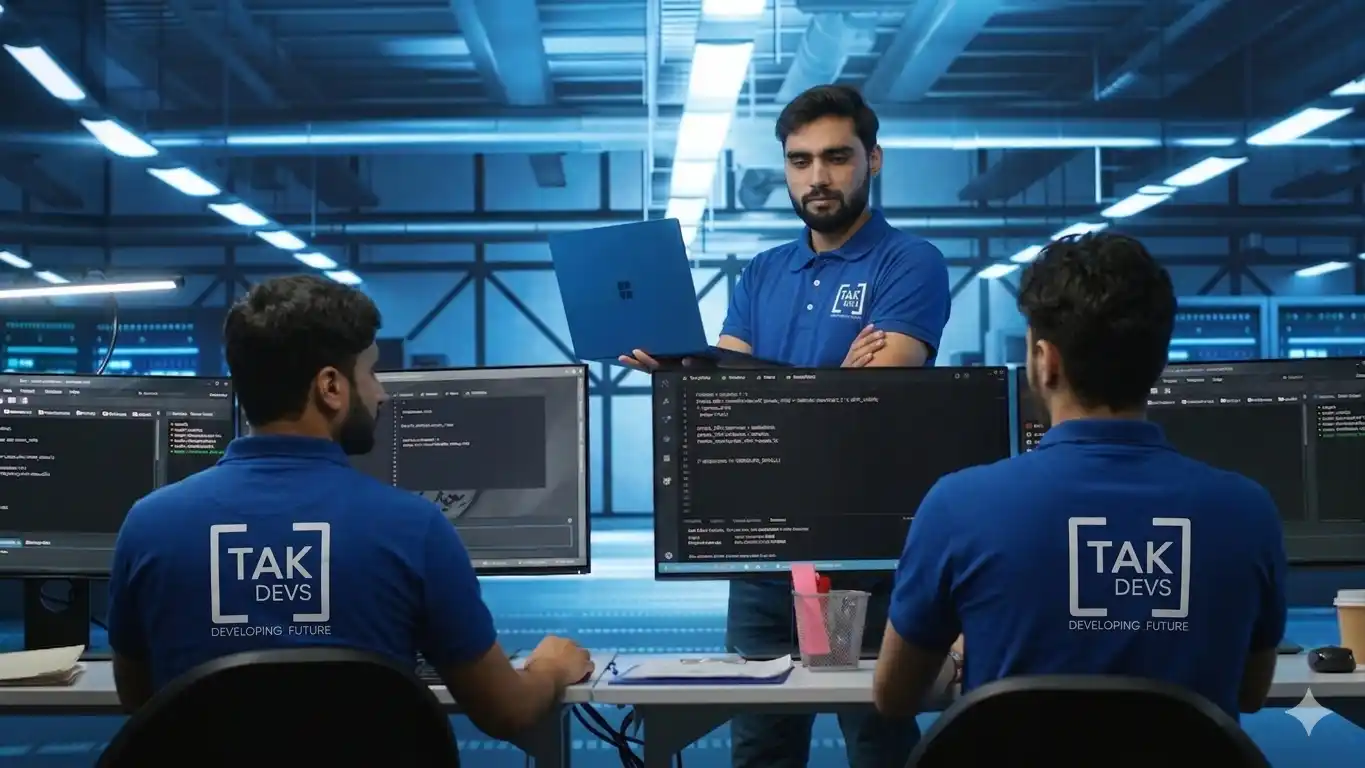
TAK Devs took on the full product lifecycle.
In six sprints and twelve weeks, we delivered:
Four connected portals covering Patient, Therapist, Admin, and Institutional workflows
Real-time video consultations via WebRTC, integrated Stripe payments, and smart scheduling
100% HIPAA-aligned architecture with full encryption across all data flows
Automated credential verification that reduced therapist onboarding time by 70%
CI/CD pipelines, automated testing, and AWS-based deployment ready for production from day one
Testimonials
I'm happy with TAK Devs Pvt Ltd's work quality. Our engagement with TAK Devs Pvt Ltd is a huge success. Our project is very complex and has many engineering metrics and variables, and the team delivers high-quality work.

TAK Devs Pvt Ltd delivered a robust system designed to handle 2 million daily users, achieving a seamless integration of PDF creation as part of the authentication process. The team consistently met deadlines and was highly responsive, flexible, transparent, understanding, and proactive.

Thanks to TAK Devs Pvt Ltd, the client can seamlessly track session duration, user engagement, and login metrics. They also can efficiently monitor appointment bookings, assess client-therapist match rates, and collect feedback. The service provider's knowledge and quality delivery are exemplary.

TAK Devs Pvt Ltd delivered a functional POC and offered detailed guidance throughout the development process. The team was helpful in explaining the project's complexities for the client to understand everything thoroughly. They communicated via virtual meetings, email, and messages.

Great communication, top understanding of Spec, autonomous development. Everything Perfect.

Real professionists, always ready to help our resident team. It's a pleasure to work with them.

Great work, implemented everything 100% as per our specifications, and very fast!

TAK Devs Pvt Ltd's efforts have been met with positive acclaim. The team is always available and communicative via virtual meetings and email. Their software development expertise and listening skills make them stand out.



Frequently Asked Questions
What is software performance optimization?
Software performance optimization is the process of making an application faster, more stable, and cheaper to run by measuring its behavior, finding bottlenecks, and fixing them in the code, database, network, frontend, or infrastructure. It is an ongoing discipline rather than a one-time task, because new features, data growth, and traffic changes keep creating new bottlenecks.
How do I know if my app has a performance problem or just needs more servers?
If adding servers helps only briefly, or cloud costs rise faster than your user base, the problem usually sits in the code, queries, or architecture rather than in capacity. A profiling-based performance audit shows whether time is lost to CPU, database, network, or frontend work, which tells you whether to optimize or to scale.
- Latency that stays high at low traffic points to code or query issues
- Latency that only climbs at peak points to capacity or concurrency limits
- Rising error rates under load point to resource exhaustion
How long before we see results from performance optimization?
Quick wins often appear within the first few weeks, because an audit tends to surface fixes such as missing indexes, caching gaps, or oversized frontend bundles. Deeper work, like refactoring hot code paths or re-architecting a service, usually runs across several bi-weekly sprints, depending on codebase size and how much risk each change carries.
How much does a software performance optimization engagement cost?
Cost depends on system size, the number of layers involved, and whether you need a one-off audit or ongoing optimization. TAK Devs usually starts with a fixed-price performance audit, so you know the cost upfront and receive a ranked fix list before committing to any larger engagement.
- Fixed-price audit for a defined scope
- Sprint-based delivery for the fixes you choose
- Optional ongoing monitoring and support
Will performance optimization break existing features?
It should not, provided every change is benchmarked, tested, and released gradually. TAK Devs validates optimizations with automated regression tests, load tests, and manual QA, then rolls them out through staged deployments or feature flags, so unexpected behavior is caught and reversed before it reaches most users.
Is autoscaling a substitute for performance optimization?
No, autoscaling adds capacity when load increases, but it does not make inefficient code, slow queries, or heavy pages any faster. It is useful for absorbing traffic spikes, yet relying on it alone means paying for extra servers to run the same slow work, which is one reason wasted cloud spend stays high.
Which metrics matter most for measuring software performance?
The most useful metrics are response time at the 95th and 99th percentiles, throughput, error rate, and CPU and memory utilization, plus Google’s Core Web Vitals for web applications. Priorities depend on the user journey: checkout and login flows usually need tighter latency targets than background reporting jobs.
Do you need access to our source code and production environment?
Read access to code, monitoring data, and a production-like environment gives the most accurate results, but production write access is not needed to start. TAK Devs signs NDAs and data protection agreements before any access, follows ISO 27001-certified security processes, and can work with anonymized data where privacy rules require it.
Can you optimize AI and LLM-powered features?
Yes, AI feature performance can be improved by streaming responses, caching repeated queries, routing simple requests to smaller models, and tuning retrieval pipelines. These changes reduce how long users wait for an answer and lower the inference cost per request, which matters more as AI usage grows inside a product.
Does website performance affect SEO rankings?
Yes, as one signal among many. Google uses Core Web Vitals in its ranking systems, and rates an experience as good when Largest Contentful Paint is within 2.5 seconds, Interaction to Next Paint is within 200 milliseconds, and Cumulative Layout Shift is below 0.1, so frontend optimization can support organic visibility and conversions together.
What happens if we start and it turns out not to be the right fit?
If the audit shows you do not need a performance engagement, or another specialist would serve you better, TAK Devs will say so and point you in the right direction. There is no long-term lock-in, and you keep every finding, benchmark, and recommendation from the audit, whatever you decide next.
How do we stop performance from degrading again after the work is done?
Performance stays healthy when it is measured continuously and enforced in the release process. TAK Devs adds performance budgets and load tests to your CI/CD pipeline, sets up monitoring and SLO alerts, and documents every optimization, so your team catches regressions at the merge request instead of hearing about them from customers.