




What We Build
Software maintenance and support services, split by what breaks.
ISO/IEC/IEEE 14764, the international standard for software maintenance, sorts the work into four types. Most vendors bundle them into one vague retainer, so here is what each one actually covers.
| Type | What it covers | Real-world example |
|---|---|---|
| Corrective | Fixing defects found in live software | A checkout bug that fails on one browser |
| Adaptive | Keeping software working as its environment changes | Moving off a runtime that lost security support |
| Perfective | Improving performance and usability | Speeding up a slow reporting page |
| Preventive | Reducing future failures before they happen | Refactoring a fragile module before it breaks |
Bugs Fixed, Not Debated
Corrective maintenance and incident response for software already in production.
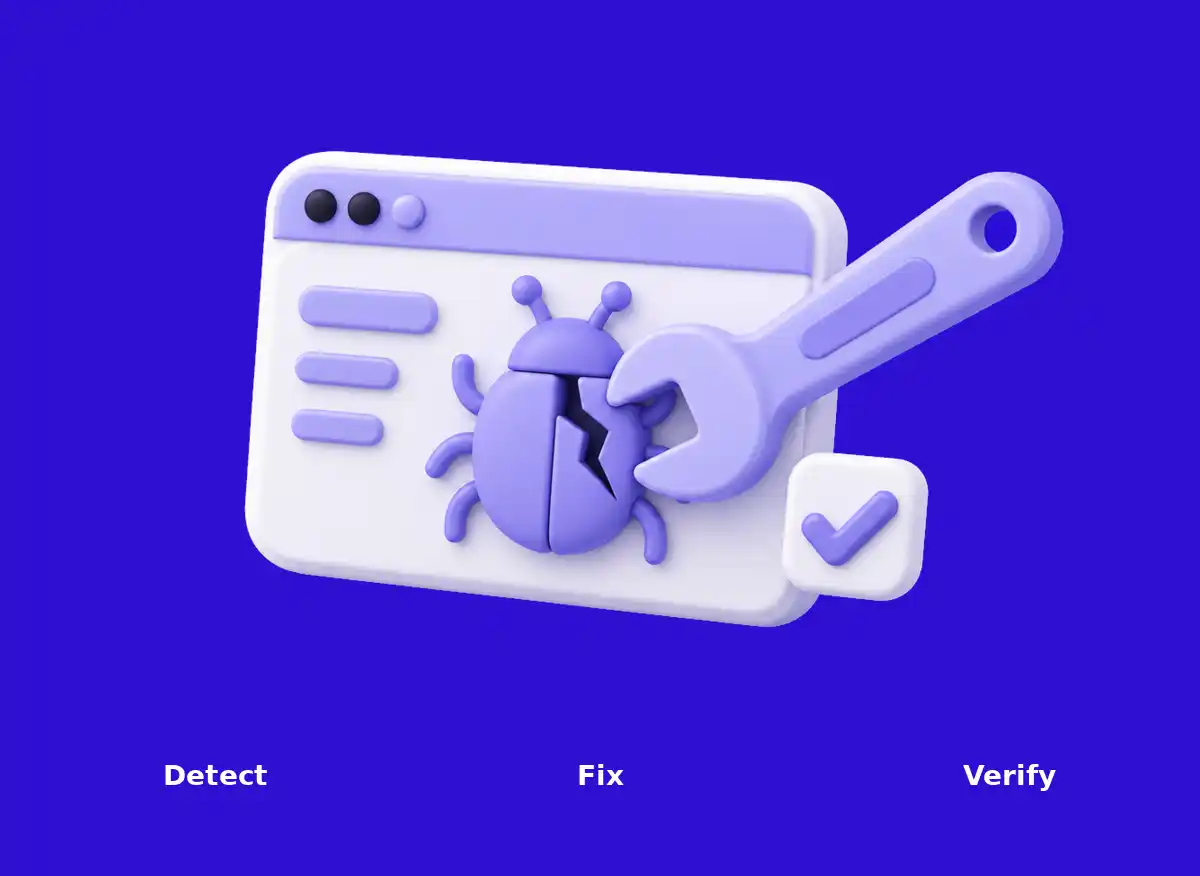
Corrective maintenance is the work of fixing defects found in live software. We triage by business impact, not by who emailed loudest.
- Triage by severity, with levels agreed in writing before the first incident
- Root-cause fixes, so the same bug does not return next quarter
- A hotfix path for production emergencies, with a rollback plan ready
- Post-incident write-ups your leadership can read in two minutes
- A regression test added for every bug we fix
Updates Before Deadlines
Adaptive maintenance for runtimes, APIs and platforms that keep moving.
Adaptive maintenance keeps software working when the world around it changes. Node.js 20, for example, reached end of life on April 30, 2026, according to the Node.js Release Working Group schedule, and no longer receives security patches.
- Runtime and framework upgrades planned before end-of-life dates, not after
- Third-party API and SDK changes tracked and absorbed
- Browser, operating system and app store requirement updates
- Dependency updates in small batches, so one bad version cannot sink a release
Performance That Holds Up
Perfective maintenance that makes working software faster and simpler.
Perfective maintenance improves software that already works. Slow pages and clumsy flows cost you customers quietly, with no outage banner to warn you.
- Performance profiling and query tuning on real production traffic
- UX fixes for the screens where users abandon most
- Load testing before your next campaign or seasonal peak
- Small improvements shipped every sprint, not saved for a big-bang release
- Cloud cost reviews that typically identify 20-35% savings
Patches Before Breaches
Preventive maintenance and security patching on a schedule, not panic.
Preventive maintenance fixes weak spots before they fail. According to Verizon’s 2026 Data Breach Investigations Report, exploiting software vulnerabilities is now the leading way into breached systems, behind 31% of breaches, ahead of credential abuse at 13%.
- Monthly security patching, with a fast lane for critical vulnerabilities
- Dependency and license scans, with a software bill of materials on request
- Refactoring of fragile modules, so technical debt stops compounding
- Application security reviews and DevSecOps checks wired into the pipeline
- Backup and restore drills, because an untested backup is just a hope
Alerts Before Customers
Monitoring that pages the right person, not the whole company.
Monitoring is how you hear about problems before your customers do. IBM’s 2026 Cost of a Data Breach Report puts the average time to identify and contain a breach at 247 days, and breaches that ran past 200 days cost $5.65 million on average versus $4.32 million for faster ones.
- Uptime, error-rate and latency alerts tied to business thresholds
- Log aggregation and tracing, so engineers find the cause faster
- Alert tuning, because 200 alerts a day means none get read
- Status reports your non-technical stakeholders can follow
- Uptime commitments written into the SLA, not promised on a sales call
Support That Picks Up
Helpdesk, troubleshooting and escalation paths your users can actually find.
Support means a human answers when a user is stuck, and the right engineer hears about it fast. We route every issue by severity, so a typo never outranks an outage.
- Response and resolution targets written into your SLA before work starts
- Intake through the ticketing tool, email or chat your team already uses
- An escalation path with named contacts, not a shared inbox
- A monthly report: tickets opened, tickets closed and recurring causes
Upgrades Without Downtime Drama
Migrations and version upgrades planned so users barely notice.
Migrations move software to new infrastructure, platforms or versions. We rehearse every cutover in staging first, because production is a terrible place to discover surprises.
- Cloud migrations to AWS, Google Cloud or Microsoft Azure, with an architecture review first
- Legacy modernization in phases, so the business keeps running while the code improves
- Database and framework version upgrades with tested rollback plans
- Staging rehearsals with a rollback plan agreed up front
- Data integrity checks before and after every migration
Docs Your Team Reads
Runbooks and training so knowledge stops living in one head.
Documentation is a maintenance feature, not a nice extra. When the one person who understands the billing job goes on vacation, this is what keeps you calm.
- Runbooks for every common incident type, so anyone on call can act
- Architecture and data-flow diagrams updated as the system changes
- Onboarding guides for new engineers joining your team
- Short training sessions for support staff and administrators
- Release notes written for humans, not for compilers
Audit-Ready, Not Audit-Panicked
Compliance upkeep for HIPAA, GDPR and ISO-aligned environments.
Compliance is not a launch milestone you pass once. IBM’s 2026 report found healthcare has the costliest breaches of any industry, at $6.64 million on average, for the 13th year running.
- Patch logs, access reviews and audit trails kept ready for auditors
- Data retention and deletion jobs maintained as rules change
- Work runs under ISO 27001-certified security processes
- Final compliance decisions stay with your legal counsel and auditors, and we supply the technical evidence
Trusted and recognized across the industry




How TAK Devs Works
Process diagrams look the same at every agency. What matters is what actually happens inside each phase. Here is how we work in practice, refined across 150+ delivered projects.
- 150+ projects delivered
- ISO 9001 quality certified
- ISO 27001 security certified
Discovery Call
We uncover what you actually need first.
Output: problem briefScoping Workshop
Goals become a costed, prioritised delivery plan.
Output: scope and roadmapSprint Delivery
Tested, working software shipped every sprint.
Output: working softwareLaunch & Handoff
Live deployment, full docs, clean knowledge transfer.
Output: live product and docsOngoing Support
We monitor, maintain, and scale after launch.
Output: monitored and maintainedNot sure which phase you are in? Start with a discovery call and we will tell you honestly.
Book a discovery callStruggling to keep up with development demands?
See how we can streamline your workflow.
No commitment required | Takes 20 minutes !
Who We Work With
The fear first, then the fix we actually deliver.
Founders
CTOs and VPs Engineering
Ops Leaders
Product Managers
Compliance Leads
Industries We Serve
Same maintenance discipline, tuned to each sector's risks.
Health tech
HIPAA-aligned upkeep, access reviews and audit trails (see UpliftCare).
Fintech
Patch speed, access control and audit evidence for regulated data.
Legal tech
Confidential data, strict access rules and dependable document workflows.
SaaS
Uptime, predictable releases and quick bug turnaround for paying users.
Retail
Checkout stability and load readiness for peak season.
Travel and mobility
Booking flows and integrations that cannot fail on a Friday afternoon (experience includes Holiday Horse, a German accommodation marketplace).
AI products
Application and data pipeline upkeep (experience includes RegioKI, an agentic AI SaaS for German SMEs).
Why Teams Pick TAK Devs
Fixed-Price Scoping
Fixed-price options for scoped maintenance work. Rates and scope in writing, so surprise invoices have nowhere to hide. A 4-Week Technical Audit gives you a real number before you commit.
One Team, Whole Lifecycle
TAK Devs owns strategy, UI/UX, development, QA, cloud and maintenance, so nobody can point at another vendor. 150+ projects delivered across the US and Europe.
Compliance Day-One
100% HIPAA compliance achieved day-one on UpliftCare. ISO 9001 and ISO 27001 certified.
Delivery You Can Check
12-week average delivery from brief to launch. Bi-weekly sprints, with working software shown every cycle. 5★ Clutch rating from verified reviews.
Boutique Capacity
We take on a limited number of new engagements each quarter to maintain delivery quality. Senior-led delivery, with no junior staff hidden behind partner logos. If there is no fit, we will point you to who is better suited.
What Working With TAK Devs Actually Looks Like
In early 2025, UpliftCare came to us with a clear challenge and a tight window. They needed a complete, HIPAA-compliant telehealth marketplace connecting patients, verified therapists, and healthcare institutions. The deadline was three months, set by an investor presentation they could not move.
There was no technical architecture. No defined roadmap. Just a vision and a date.
TAK Devs took on the full product lifecycle.
In six sprints and twelve weeks, we delivered:
Four connected portals covering Patient, Therapist, Admin, and Institutional workflows
Real-time video consultations via WebRTC, integrated Stripe payments, and smart scheduling
100% HIPAA-aligned architecture with full encryption across all data flows
Automated credential verification that reduced therapist onboarding time by 70%
CI/CD pipelines, automated testing, and AWS-based deployment ready for production from day one
Testimonials
I'm happy with TAK Devs Pvt Ltd's work quality. Our engagement with TAK Devs Pvt Ltd is a huge success. Our project is very complex and has many engineering metrics and variables, and the team delivers high-quality work.

TAK Devs Pvt Ltd delivered a robust system designed to handle 2 million daily users, achieving a seamless integration of PDF creation as part of the authentication process. The team consistently met deadlines and was highly responsive, flexible, transparent, understanding, and proactive.

Thanks to TAK Devs Pvt Ltd, the client can seamlessly track session duration, user engagement, and login metrics. They also can efficiently monitor appointment bookings, assess client-therapist match rates, and collect feedback. The service provider's knowledge and quality delivery are exemplary.

TAK Devs Pvt Ltd delivered a functional POC and offered detailed guidance throughout the development process. The team was helpful in explaining the project's complexities for the client to understand everything thoroughly. They communicated via virtual meetings, email, and messages.

Great communication, top understanding of Spec, autonomous development. Everything Perfect.

Real professionists, always ready to help our resident team. It's a pleasure to work with them.

Great work, implemented everything 100% as per our specifications, and very fast!

TAK Devs Pvt Ltd's efforts have been met with positive acclaim. The team is always available and communicative via virtual meetings and email. Their software development expertise and listening skills make them stand out.

Frequently Asked Questions
What are software maintenance and support services?
Software maintenance and support services are the ongoing work that keeps software running after launch: fixing bugs, applying security patches, updating dependencies, improving performance, monitoring uptime and helping users who get stuck. TAK Devs delivers them as scoped, SLA-backed engagements, so you know what is covered, how fast we respond and what it costs before work begins.
- Maintenance changes the software: fixes, updates and improvements
- Support helps people use it and routes problems to engineers
- Both run together under one team and one agreement
What is the difference between software maintenance and software support?
Software maintenance changes the software itself through bug fixes, patches, upgrades and performance work, while software support helps people use it and routes their problems to the right engineer. Most teams need both, and they work best when one team owns both, so nothing falls between two vendors.
- Maintenance example: replacing a vulnerable library
- Support example: a user cannot log in and is guided to a fix
- Splitting the two across vendors can slow ticket resolution
What are the four types of software maintenance?
The four types of software maintenance are corrective (fixing defects), adaptive (keeping software working as its environment changes), perfective (improving performance and usability) and preventive (reducing future failures). They are defined in ISO/IEC/IEEE 14764, the international standard for software maintenance, and a healthy plan budgets for all four.
- Skipping preventive and adaptive work tends to push everything into emergency corrective work
- Perfective work is the easiest to postpone and the easiest for users to notice
How much do software maintenance and support services cost?
Cost depends on your codebase, integrations, compliance load, coverage hours and required response times, so any flat percentage quoted without reviewing your system is a guess. TAK Devs scopes maintenance from your actual code and incident history, puts it in writing, and offers fixed-price options for scoped work.
- A 4-Week Technical Audit produces a real number before you commit
- No long-term lock-in and no surprise invoices
- For scale, IBM’s 2026 Cost of a Data Breach Report puts the global average breach at $4.99 million
How do I know if my software needs maintenance right now?
Your software needs maintenance now if bugs keep returning, releases feel risky, pages are slowing down, runtimes or dependencies are past end of life, or only one person understands how it works. Any one of those signals means risk is building faster than your team is paying it down.
- A runtime past end of life, such as Node.js 20 after April 30, 2026, no longer gets security patches
- Alerts that are ignored or muted
- Backups that have never been test-restored
Can you take over software that another vendor built?
Yes, we maintain software we did not build, starting with a 4-Week Technical Audit that reads the code, maps the risks and produces a prioritized fix list before any maintenance commitment. You learn what you actually own, and we learn what we are taking on.
- We sign NDAs and data protection agreements before touching your code or data
- The audit covers code quality, security gaps, test coverage, infrastructure and documentation
- If we are not the right fit, we will say so and point you to who is better suited
What if we start and TAK Devs turns out not to be the right fit?
If TAK Devs turns out not to be the right fit, you can stop with no long-term lock-in. Scoping is transparent and in writing before any work starts, and if the audit or first sprints show we are the wrong fit, we will say so and point you toward who is better suited.
- Start small, with an audit or a scoped sprint rather than a long contract
- Honest scoping: no fluff proposals and no surprise invoices
- No commitment is required to talk, and the first call takes 20 minutes
How fast will you respond when something breaks in production?
Response and resolution targets are set by severity in a written SLA before work starts, so a production outage gets the fastest path and a cosmetic bug does not compete with it. We agree severity definitions, coverage hours, escalation contacts and reporting during the scoping workshop, not during the incident.
- Critical: production is down or data is at risk
- Medium: a feature is degraded but a workaround exists
- Low: cosmetic issues and small requests
- A monthly report shows whether targets were met
Is it cheaper to maintain software in-house or with an agency?
It depends on workload: in-house works best when maintenance is a full-time job you can hire and retain for, while an agency fits teams that need predictable cover without building a team. Salaries are paid in quiet months too, whereas a scoped engagement follows the work.
- Many teams split the load: in-house owns the roadmap and the agency owns upkeep
- In-house advantage: closeness to the business and its context
- Agency advantage: documented runbooks and coverage that does not hinge on one person’s calendar
- Agency trade-off: regular syncs are needed to keep context fresh
Can you keep our software HIPAA and GDPR compliant?
We build and maintain software to HIPAA-aligned and GDPR-aligned practices, including patching, access reviews, audit trails and data retention jobs, under ISO 27001-certified security processes. Compliance decisions remain with your legal counsel and auditors, and we supply the technical evidence they need.
- UpliftCare reached 100% HIPAA compliance day-one
- Patch logs and access reviews are kept ready for audits
- We flag technical gaps, but we do not give legal advice