AI Agent Development Services at a Glance
If you have spent any time shopping for AI agent development services in 2026, you already know the feeling. Every vendor sounds confident, every landing page promises autonomous workflows, and every pitch deck has the word "agentic" sprinkled across it like seasoning. The hard part is not finding a company. It is finding one that can actually move a pilot into production.
What AI Agent Development Services Actually Mean in 2026
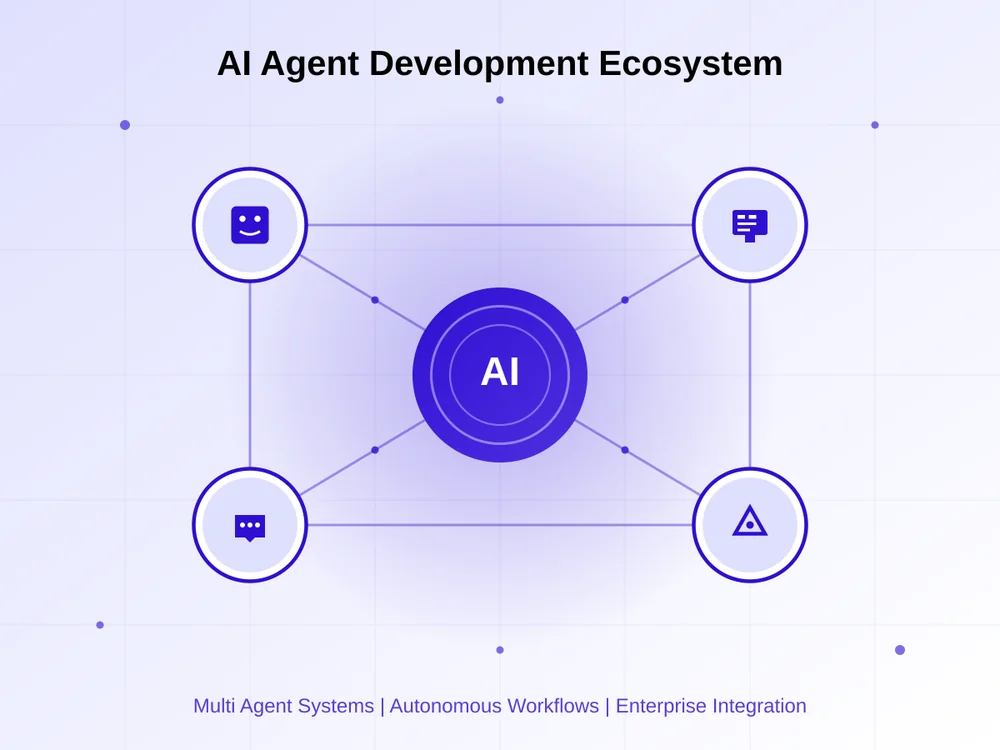
An AI agent is a software system, usually built on top of a large language model, that can perceive a situation, reason about it, decide on a course of action, use external tools, and complete a task with little or no human input. The keyword is act. A chatbot answers a question. An agent reads the question, pulls data from your CRM, drafts an action, executes it through an API, and writes back to a system of record. The difference is the difference between a clerk who reads a memo and an employee who actually carries out the work described in it.
AI agent development services are the end to end engineering work needed to design, build, train, integrate, deploy, and maintain those agents in real production environments.
According to IBM's 2026 CEO study, around seventy percent of executives say agentic AI is important to their organisation's future, and that bet is now translating into real procurement budgets. At TAK Devs we treat AI agent work as a full software engineering discipline, not a prompt writing exercise.
What buyers usually want from a vendor in this space is some combination of the following:
- Consulting and strategy, where the vendor helps decide whether an agent is actually the right solution, which model family fits, and where the early wins will come from.
- Custom agent development, including single agent and multi agent architectures, prompt and tool design, fine tuning, and orchestration logic.
- System integration, connecting the agent to CRMs, ERPs, data warehouses, ticketing systems, and the rest of the existing enterprise stack.
- Evaluation, guardrails, and governance, so the agent behaves predictably in regulated workflows.
- Deployment and lifecycle management, covering retraining, monitoring, security updates, and capability expansion as the business evolves.
Why Businesses Are Investing in AI Agents This Year
The honest answer is that 2025 was the year of the proof of concept and 2026 is the year of the production system. Executives have seen the demos. Now they want measurable returns. The shift from experiment to deployment is showing up in procurement budgets, hiring patterns, and board level OKRs across every major industry.
Real production agents are now reducing handle times in support centres, catching fraud in real time, reconciling invoices overnight, and surfacing trading signals that would have taken a small team a week to find manually. The cost of not investing is no longer a missed efficiency. It is a competitor who has quietly compounded a year of operational advantage while you ran another evaluation cycle.
The five outcomes vendors are being asked to deliver, in roughly the order we hear them on sales calls:
- Operational efficiency. Agents handle multi step tickets, document review, code fixes, and data reconciliation that used to require a small team. IBM's research suggests roughly eighty three percent of companies expect agents to improve process throughput.
- Cost reduction. Routine work that scales with headcount stops scaling with headcount. About two thirds of C level executives believe automation will lower operating expenses meaningfully over the next two years.
- Customer experience. Twenty four seven, context aware, and personalised responses are now the table stakes for any consumer facing brand.
- Decision quality. Agents that watch data streams in real time and surface anomalies or recommendations help leaders make faster, better informed calls.
- Competitive advantage. Early adopters get the institutional muscle, the integration patterns, and the internal evangelists. Late adopters get to read about it in case studies.
If your business case touches even two of those five outcomes, an agent project is worth scoping. The trick is to pick a use case that is narrow enough to ship and meaningful enough to matter.
Chatbot vs AI Agent: The Real Difference
The terms are used interchangeably in marketing copy, but they describe very different pieces of software. A chatbot is a conversational interface that replies. An AI agent is an autonomous worker that acts. Understanding this gap is the first step to scoping a project that actually moves a business metric.
A chatbot replies that your order has shipped. An AI agent looks up the order, generates the shipping label, updates the system of record, emails the customer, and flags any exception that needs human review. Both are useful. Only one is doing the work.
How chatbots and AI agents diverge across the criteria that matter most for buyers:
| Criteria | Traditional Chatbot | AI Agent (TAK Devs) |
|---|---|---|
| Primary Goal | Answer a question or route a request | Complete a task end to end |
| Reasoning | Scripted flows or single turn LLM reply | Multi step planning and tool selection |
| Tool Use | Limited, often none | APIs, databases, internal systems, other agents |
| Memory | Session only, often none persistent | Short and long term memory across interactions |
| Autonomy | Waits for user input at every step | Acts independently within defined guardrails |
| Output | Text reply | Completed work plus reply, audit log, and system updates |
| Best Use Case | FAQ deflection and lightweight support | Multi system workflows, complex decisions, autonomous operations |
Both still belong in the toolkit. The point is to choose deliberately. If your goal is to deflect support volume, a well tuned chatbot can be enough. If your goal is to reconcile invoices across three systems before a human even logs in, you need an agent. Our wider solutions portfolio covers both depending on the maturity of the use case.
Core AI Agent Development Services TAK Devs Delivers
AI agent work touches strategy, engineering, integration, and operations. Most projects fail because one of those four legs is missing. We deliver all four under one roof so the agent that ships is the agent your business actually needed.
The seven service tracks that make up a complete TAK Devs AI agent engagement:
- AI Strategy and Feasibility. Before a line of code, we map your workflows, identify automation candidates, score them by impact and feasibility, and define success metrics. Most clients leave this phase with a shortlist of use cases, a target ROI band, and a clear answer to the build vs buy question.
- Custom AI Agent Development. We design and build single agents for focused tasks and multi agent systems for end to end workflows. That includes choosing between open source and commercial LLMs, fine tuning where it earns its keep, designing tool calling patterns, and building memory and retrieval layers.
- Multi Agent Orchestration. When one agent is not enough, we design teams of agents that coordinate through structured protocols. We use frameworks like LangGraph and custom orchestration where it makes sense, and we are honest about when a simpler pipeline beats a fancy graph.
- LLM Fine Tuning and Retrieval Augmented Generation. Generic models do not know your products, your policies, or your tone. We bring them up to speed using a mix of fine tuning, RAG, and structured tool use so the agent sounds like your business and stays grounded in your data.
- Enterprise System Integration. An agent that cannot reach Salesforce, SAP, ServiceNow, or your internal data lake is a demo. We build the secure connectors, event pipelines, and API layers needed to make agents first class citizens inside your stack.
- Evaluation, Guardrails, and Governance. Human in the loop checkpoints, fallback logic, prompt injection defences, and audit trails are part of the default scope, not an afterthought. This is where most projects quietly fail.
- Deployment, Monitoring, and Continuous Improvement. We monitor agent behaviour, retrain on new data, expand capabilities, and tune costs. Our SRE practice treats token usage and latency as first class operational metrics.
Six Types of AI Agents We Build
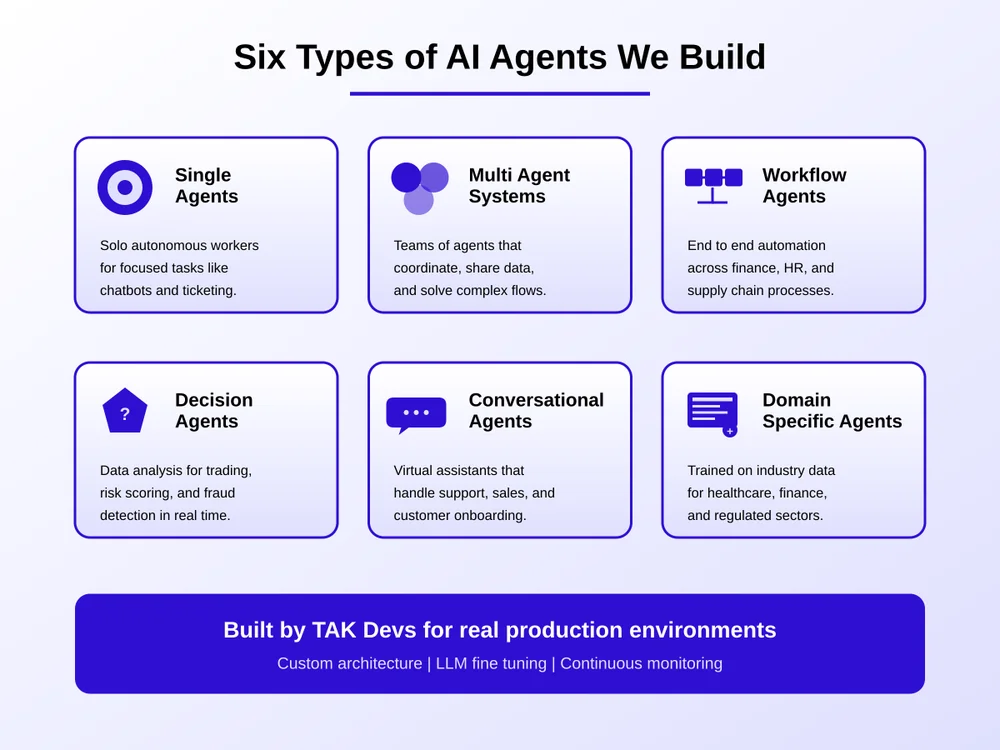
Not every task needs an autonomous swarm. The art is matching the agent pattern to the problem. We have shipped each of the six patterns below and can tell you with a straight face when a one page script would have done the same job for ten percent of the cost.
The six agent patterns that cover almost every enterprise use case in 2026:
- Single agent solutions handle one well scoped task such as triaging support tickets, generating product descriptions, or summarising meeting transcripts. Low cost to build, low cost to run, and often the right starting point.
- Multi agent systems let several specialised agents collaborate on multi step workflows. Common in finance, supply chain, and any process that spans several data sources or decision points.
- Task specific single agents automate well defined back office work like invoice matching, document classification, and knowledge retrieval. They live quietly inside business applications and rarely meet the end user.
- Conversational and virtual assistant agents handle interactive use cases including customer support, employee help desks, and sales qualification.
- Decision and analytical agents watch data streams and either recommend or execute actions. Algorithmic trading, fraud detection, predictive maintenance, and risk scoring all fall here.
- Domain specific intelligent agents are trained for industries with strict rules. Healthcare, financial services, insurance, and legal are the obvious examples.
Scoping an AI Agent Project for Your Business?
TAK Devs designs, builds, and deploys production grade AI agents for SaaS, finance, healthcare, e-commerce, and B2B enterprises. Explore how our enterprise solutions map to your automation and growth goals.
Industries Where AI Agents Are Earning Their Keep in 2026
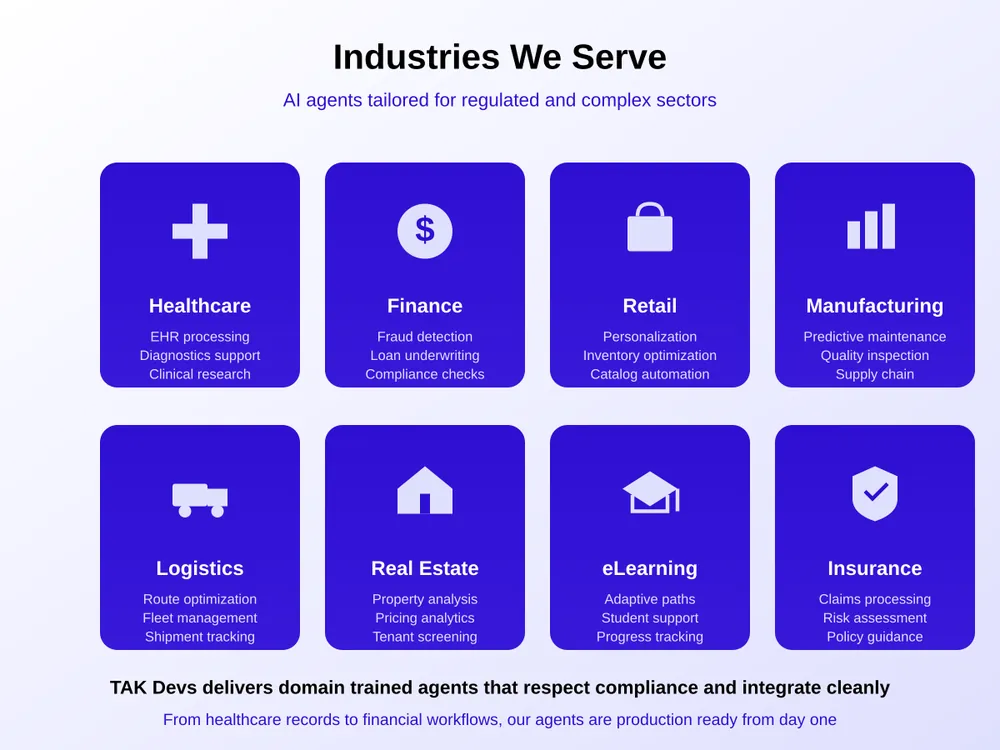
Each industry has its own data structures, regulations, and integration patterns. Here is where agents are paying for themselves today.
The sectors where we see the most consistent ROI from production AI agents:
- Healthcare and Life Sciences. Patient scheduling, electronic health record processing, clinical decision support, and medical imaging analysis. Most providers also need help with PII protection, so HIPAA fluency is non negotiable when picking a vendor.
- Financial Services and Trading. Fraud detection, anti money laundering monitoring, loan underwriting, KYC processing, algorithmic trading strategy support, and portfolio risk control. The volume is huge and the regulators are awake.
- Retail and E-commerce. Catalog enrichment, AI driven search, customer segmentation, personalised recommendations, dynamic pricing, and post purchase support. Margins are tight, so agents that move conversion or cut returns pay for themselves quickly.
- Manufacturing. Predictive maintenance from IoT sensor streams, AI driven quality inspection, supply chain visibility, and demand forecasting. Production downtime is expensive, which makes the ROI math friendlier than in most sectors.
- Transportation and Logistics. Route and schedule optimisation, fleet diagnostics, warehouse robotics coordination, and shipment tracking. The best agents combine LLM reasoning with classical solvers.
- Insurance. Automated claims processing, risk assessment, policy recommendations, and document extraction. The paperwork heavy nature of the industry is almost embarrassingly well suited to agentic workflows.
- Real Estate. Property valuation, personalised property matching, tenant screening, and transaction coordination. Especially useful for portfolios where data lives in twenty different places.
- eLearning. Adaptive learning paths, automated grading, student onboarding, and personalised tutoring. Privacy and age appropriate design matter here more than elsewhere.
If your industry is not on the list, do not panic. The patterns transfer. Energy, telecom, agriculture, and the public sector are all running active programs and have similar integration shapes.
Why TAK Devs for AI Agent Development
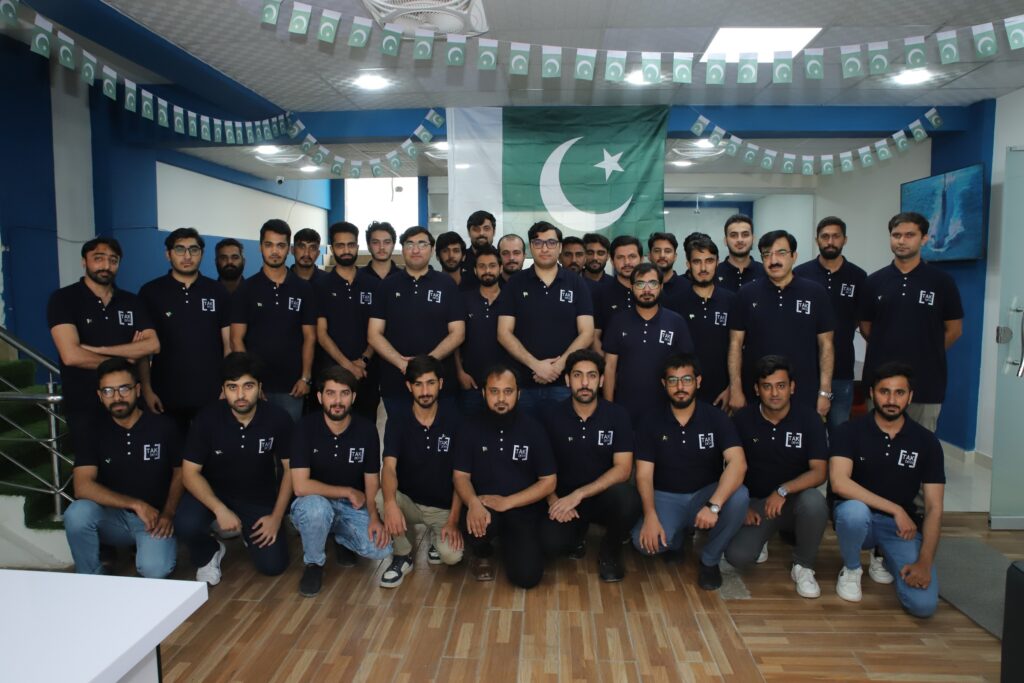
AI agent work is not a marketing trend we picked up six months ago. TAK Devs has been shipping production AI long before agentic became a buzzword. Our team combines ML engineers, data platform specialists, and software architects under one roof, which matters when an agent project touches everything from prompt engineering to enterprise system integration.
What separates our approach:
- Engineers, not influencers. Our team includes senior ML engineers, data platform specialists, and software architects who have shipped production AI long before agentic became a marketing word.
- Industry fluency. Healthcare, finance, retail, logistics, and SaaS are our day to day. We have the integration patterns and the compliance habits already wired in.
- End to end ownership. Through our Custom AI Development Services, we take a project from a whiteboard workshop to a deployed system being monitored at three in the morning, and we do not hand it off in the middle.
- Pragmatic tooling choices. We use the frameworks that fit, not the ones that trend on social media. If a thirty line script beats a multi agent graph, we will tell you.
- Transparent commercials. Clear scopes, realistic timelines, and pricing without surprises. You will know the cost before the work starts and the variance before the invoice arrives.
How TAK Devs Builds an AI Agent: The Process
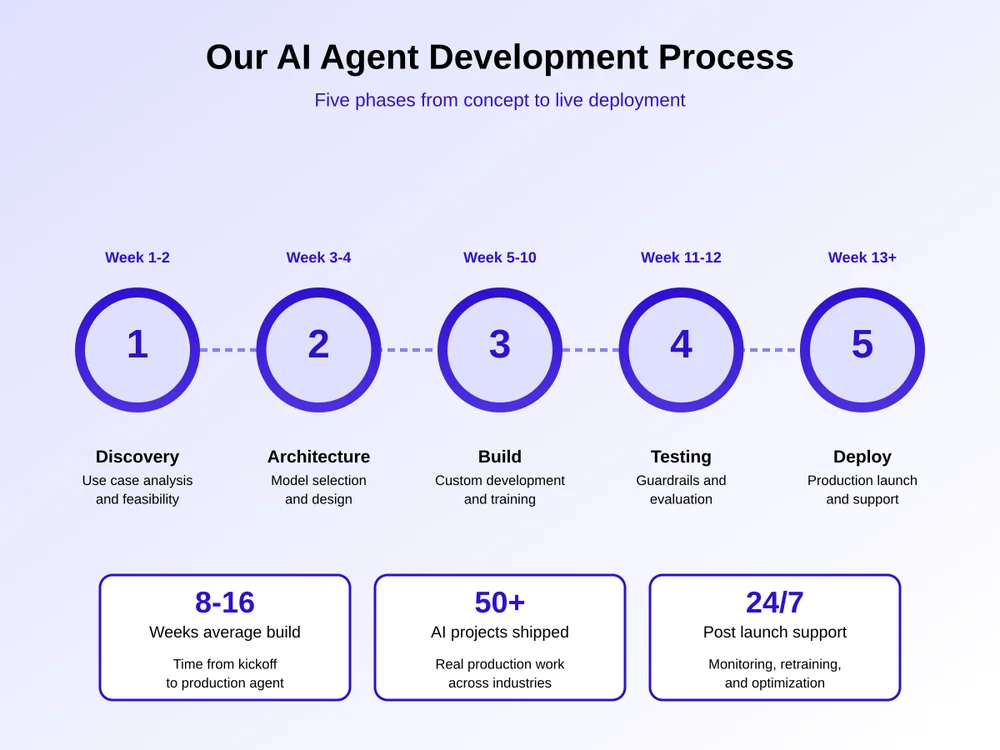
A typical TAK Devs engagement runs eight to sixteen weeks from kickoff to production agent. The phases below are the same ones we use for a five figure proof of concept and a six figure enterprise rollout. Only the depth changes.
The five phases that turn a workflow on a whiteboard into a working agent in production:
| Phase | What Happens |
|---|---|
| 1. Discovery and Feasibility | Workflow mapping, use case definition, ROI scoring, build vs buy answer |
| 2. Data and Context Foundation | Secure pipelines, retrieval strategy, RAG implementation, governance rules |
| 3. Architecture and Model Selection | Single, multi, or hybrid agent design, foundation model evaluation, tool design |
| 4. Reliability, Evaluation, Guardrails | Evaluation pipelines, grounding, fallback logic, human in the loop controls |
| 5. Integration and Deployment | Connectors to CRM and ERP, observability, security, production rollout |
| Post Launch | Monitoring, retraining, cost tuning, capability expansion |
Predictable behaviour in real workflows is the whole game. Performance is measured on task success rate, response quality, consistency, policy adherence, and operational stability rather than demo theatrics. From day one the agent operates inside your existing cloud and platform standards.
What Does AI Agent Development Cost in 2026?
This is the question every buyer asks first and every vendor dodges. We will not. The honest ranges, based on real 2026 procurement we have seen across SaaS, finance, healthcare, and manufacturing engagements, look like this.
Real 2026 cost ranges for AI agent development services, by scope:
- Proof of concept on a single, narrow use case: roughly 15,000 to 40,000 US dollars. Two to four weeks. Useful for validation, not for production.
- Production single agent with real integrations and evaluation: roughly 50,000 to 150,000 dollars. Eight to twelve weeks.
- Multi agent enterprise system with orchestration, governance, and several integrations: 150,000 to 500,000 dollars and up. Three to six months for the first release, with continuous iteration after.
- Ongoing run rate including model inference, monitoring, retraining, and human in the loop oversight: usually fifteen to thirty percent of the initial build cost per year, sometimes more if usage scales aggressively.
Anyone quoting much less is either underestimating the integration work or planning to ship you a prompt template. Anyone quoting much more is either solving a genuinely large problem or padding the bid. The trick is to scope tightly and expand once value is proven.
How to Choose an AI Agent Development Company
Every vendor's website looks great. Every case study sounds impressive. Here is the qualifying checklist we wish more buyers used when scoping AI agent development services in 2026.
The nine criteria that separate a real AI agent partner from a slide deck:
- Production references, not just demos. Ask to talk to a customer whose agent has been live for six months. The conversation tells you everything.
- Industry depth. A team that has shipped in your sector will save you months of explaining the rules.
- Integration capability. Salesforce, SAP, ServiceNow, NetSuite, Oracle, and your homegrown systems all behave differently. Hands on experience matters.
- Evaluation and governance practice. If the team cannot explain how it tests an agent, do not let it ship one to you.
- Security and compliance posture. SOC 2, ISO 27001, HIPAA, PCI DSS, GDPR, and the new EU AI Act obligations should all be familiar territory.
- Vendor lock in awareness. Ask whether you will own the weights, the prompts, the code, and the orchestration. Surprisingly often, you will not, unless you ask.
- Pricing transparency. Fixed price, time and materials, and outcome based all have a place. Ambiguity does not.
- Delivery model and time zones. Nearshore, offshore, and hybrid each have tradeoffs. Coverage hours matter more than the marketing slide suggests.
- Post launch support. Agents drift. Data changes. Models update. Make sure someone is contractually obliged to care.
If a vendor cannot answer those nine questions clearly, the conversation should pause before it becomes a contract.
The 2026 Agent Landscape and Common Mistakes to Avoid
Three shifts are worth flagging for any buyer scoping AI agent development services this year. First, model providers are racing to release agent native APIs with structured tool use, planning primitives, and stronger long context behaviour. Many tasks that needed bespoke orchestration in 2024 can now be handled with a thinner layer. Second, regulation is catching up. The EU AI Act phased obligations and the US Colorado AI Act are already shaping how high risk agents must be documented, evaluated, and monitored. Third, multi agent design is becoming standard for any workflow that crosses two or more systems.
A short list of failure patterns we see more often than we should:
- Starting with a flashy use case instead of a useful one. The agent that drafts marketing emails wins demos. The agent that reconciles invoices wins budgets.
- Skipping evaluation. If you cannot measure success, you will not get any.
- Underestimating integration. The model is ten percent of the project. Plumbing is the rest.
- Forgetting governance until the legal team finds out. Build the audit trail from day one.
- Treating an agent like a static product. It is more like an employee. It needs onboarding, supervision, and the occasional performance review.
At TAK Devs, we treat AI agent development as a long term partnership, not a one time project. The brands we work with do not just want a working demo, they want an agent that runs reliably in production a year from now. If that is what you are after too, explore the full TAK Devs solutions portfolio to see where your program fits. Good agents are built, not bought. Pick a partner who knows the difference.
Frequently Asked Questions
The questions below reflect the real concerns engineering, operations, and procurement teams face when scoping AI agent development services.
An AI agent is software that can take a goal, figure out the steps, use tools to carry them out, and finish the job with minimal supervision. Think of it as a junior employee that never sleeps, follows instructions literally, and needs clear boundaries. Unlike a chatbot that only replies, an agent acts on systems and writes results back to your data layer.
Most useful production agents take eight to sixteen weeks from kickoff. A proof of concept can land in two to four weeks. Enterprise multi agent systems with deep integrations usually run three to six months for a first release and continue evolving after launch. Timelines depend heavily on data readiness and integration complexity.
Expect roughly fifteen to forty thousand dollars for a proof of concept, fifty to one hundred fifty thousand for a production single agent, and one hundred fifty thousand to half a million or more for an enterprise multi agent system. Ongoing run costs typically land between fifteen and thirty percent of the build cost per year, depending on usage volume.
Yes, integration is the whole point. A serious development partner will connect the agent to your CRM, ERP, data warehouse, ticketing platform, and any internal APIs through secure connectors. If integration sounds like an afterthought in a vendor's pitch, that is your warning sign. We build the connectors, event pipelines, and API layers as part of every production engagement.
A chatbot answers questions. An AI agent takes action. The chatbot replies that your order has shipped. The agent looks up the order, generates the shipping label, updates the system of record, and emails the customer. Both belong in the toolkit, the point is to choose deliberately based on what you need the software to actually do.
Through guardrails, evaluation, and human in the loop controls. A well built agent has documented policies, structured tool permissions, fallback logic, audit logs, and regular evaluation against measurable behaviour metrics. It is not magic. It is engineering. We treat predictable behaviour in real workflows as the primary success metric, not demo quality.
You do. Contracts are written so that prompts, code, weights produced during fine tuning, and orchestration logic are owned by the client. Vendor lock in is something we actively avoid, not something we sneak in through licence terms. You should be able to take the agent and run it on a different infrastructure if you ever choose to.
They can, with the right controls. We implement encryption in transit and at rest, role based access, PII redaction, data residency boundaries, and audit trails. For regulated industries we align with HIPAA, GDPR, PCI DSS, SOC 2, and the relevant AI specific regulations including the EU AI Act and Colorado AI Act. Compliance is engineered in, not bolted on.
In our experience, customer support, claims processing, document heavy financial services, and predictive maintenance in manufacturing tend to show measurable ROI within two to four months. Anything with high volume, repetitive work, and clear success criteria is a good candidate. Niche or highly creative work is usually a poorer fit for early agent investments.
No, but it helps. We can run the full project end to end, or we can plug into your existing AI and engineering teams as a delivery partner. For long term programs we usually recommend a hybrid model so the client builds internal muscle as the agent matures and the cost of running the program shifts in your favour over time.
Monitoring, retraining on fresh data, expanding capabilities into new use cases, and tuning for cost and latency. Agents drift if no one is watching. A managed support arrangement, or at minimum a quarterly review cadence, is part of every production engagement we recommend. Token usage and latency are tracked as first class operational metrics.
Larger firms bring scale and brand. We bring focused engineering teams, faster decision cycles, and a delivery model where senior people stay on your project from start to finish. For enterprises that want partnership rather than presentation decks, that combination tends to work better. You get the same engineer in week one and week twenty.
Ready to Scope an AI Agent Project?
Talk to the TAK Devs team about a free 30-minute AI agent feasibility consultation. We will walk you through your highest impact use cases and identify the right next step for your business.
Schedule a Consultation