AI Optimization Services at a Glance
Search isn't what it was twelve months ago. People aren't just typing keywords into Google anymore. They're asking ChatGPT, talking to Gemini, querying Perplexity, and getting AI-generated answers before a single blue link loads. If your content isn't built for that, it's not being seen.
Quick Answer: What Are AI Optimization Services?
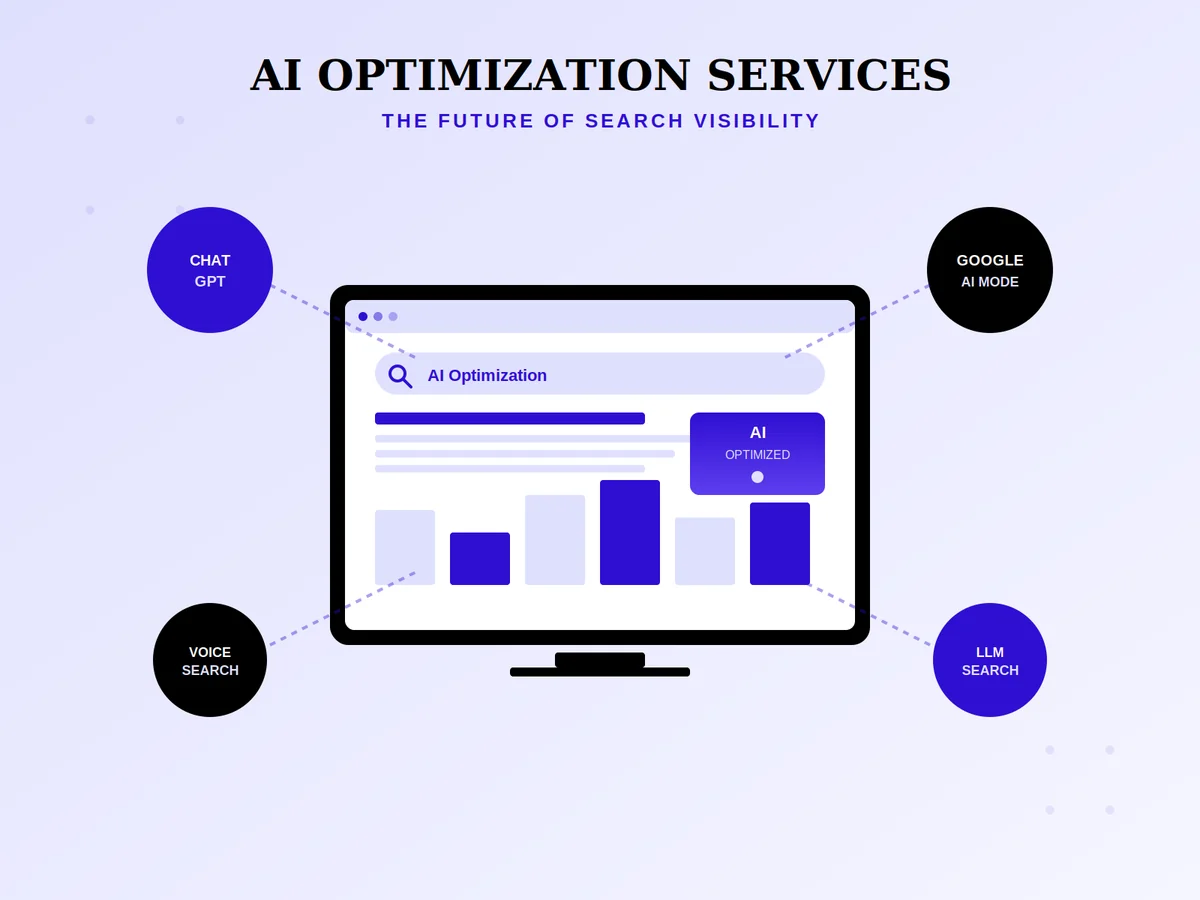
AI optimization services are the discipline of restructuring your website, content, and data so AI systems can read it, summarize it, and cite it. At Tak Devs, we've spent 2025 and the first half of 2026 helping brands transition from rank-based SEO to citation-based visibility, and the results have changed how we think about search entirely.
AI optimization services are specialized SEO services that prepare your website content to be discovered, understood, and cited by AI-powered search platforms.
This includes Google AI Mode, ChatGPT, Perplexity, Microsoft Copilot, Gemini, and voice assistants like Siri and Alexa. Unlike traditional SEO, which targets ten blue links on a search results page, AI optimization targets the answer box itself. The goal isn't to rank, it's to be the source the AI quotes when it answers a user's question.
A complete AI optimization service typically includes:
- Semantic content restructuring using H1 to H3 hierarchy that AI can parse.
- Schema markup deployment (FAQPage, HowTo, Product, Organization).
- Entity optimization so AI maps your brand to relevant topics.
- Answer Engine Optimization (AEO) for direct-answer formatting.
- Generative Engine Optimization (GEO) for LLM citation pickup.
- Conversational query targeting for natural-language search.
Why AI Optimization Matters More Than Traditional SEO in 2026
The shift is no longer subtle. Google AI Mode rolled out globally in late 2025 and now serves AI-generated answers above the standard search results for a majority of informational queries. ChatGPT crossed 800 million weekly active users in early 2026, and a growing share of those queries are commercial intent searches that used to go to Google.
Here's what that means for your website. AI tools don't just link to content anymore. They selectively summarize a handful of sources and present a single, consolidated answer. If your page isn't structured for extraction, it might never make it into the response box, no matter how well it ranks in classic search.
Recent patterns we've documented across client sites in 2026:
- AI Overviews now appear on roughly 60 to 65 percent of informational search queries.
- Click-through rates on position one have dropped 25 to 35 percent on queries with AI summaries.
- Pages cited inside AI answers see a 20 to 40 percent referral lift, even when ranked below position three.
- Voice and conversational queries now make up a meaningful share of long-tail traffic.
The cost of not optimizing for AI is no longer just losing a ranking spot. It's invisibility inside the tools your customers use every day.
Traditional SEO vs AI Optimization: The Real Difference
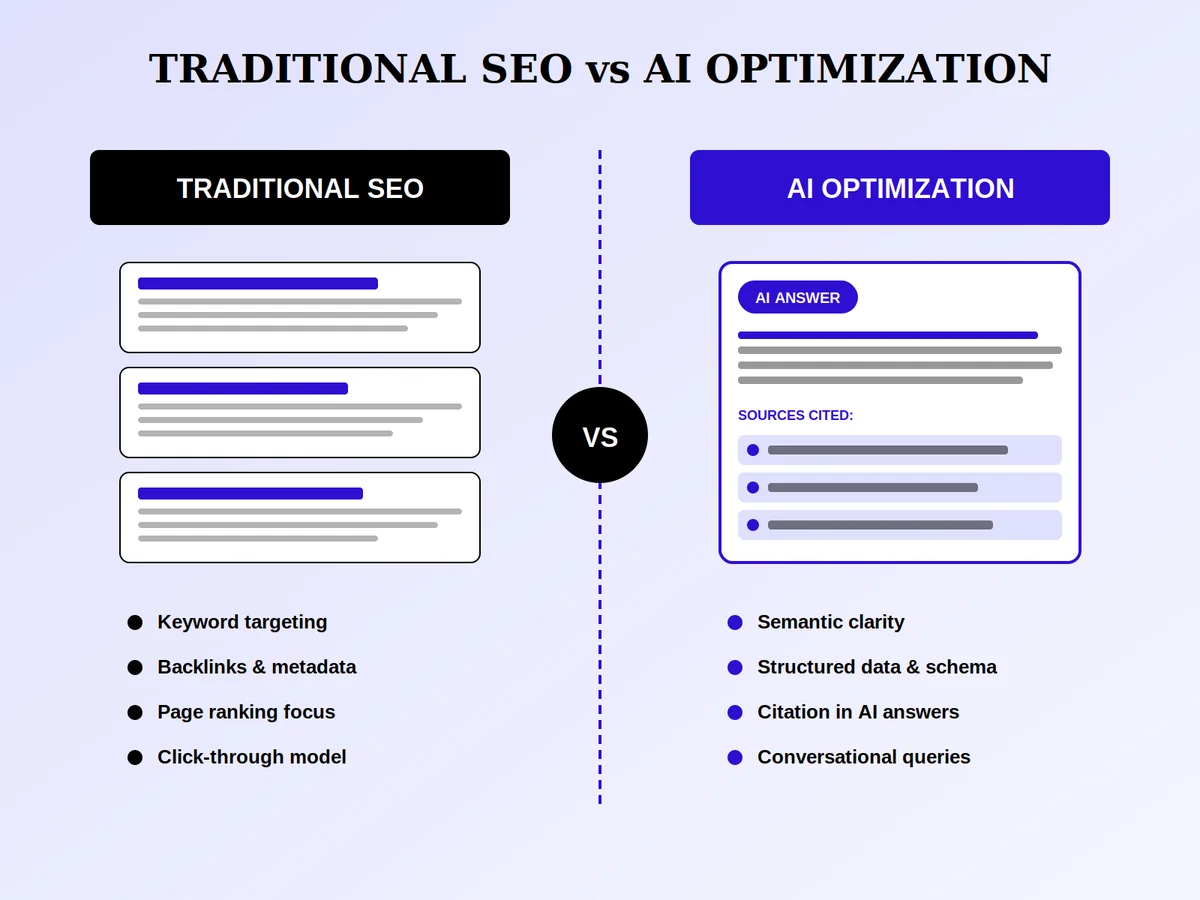
Traditional SEO is built around what crawlers index and what users click. AI optimization is built around what language models extract and what they cite. Both still matter, but the playbook is different.
Traditional SEO focuses on keyword density, backlink authority, page speed, and meta tags. These haven't gone away. AI optimization adds a second layer on top: semantic clarity, entity relationships, structured data, conversational phrasing, and content modularity. A page can rank brilliantly in classic Google search and still get skipped by ChatGPT because it's written as flowing paragraphs with no extractable answer blocks.
The brands winning in 2026 are doing both. They keep the foundation of solid technical SEO, then layer in the formatting and semantic depth that AI systems reward. That dual-track approach is exactly what we build for clients through our AI and data solutions at Tak Devs.
How traditional SEO and AI optimization diverge across the criteria that matter most:
| Criteria | Traditional SEO | AI Optimization (Tak Devs) |
|---|---|---|
| Primary Goal | Rank in top 10 blue links | Get cited inside AI-generated answers |
| Content Focus | Keyword density and backlinks | Semantic clarity and entity relationships |
| Structure | Flowing paragraphs, long-form prose | Modular answer blocks, extractable summaries |
| Schema Markup | Optional, basic implementation | Core requirement, layered deployment |
| Target Platforms | Google, Bing search engines | ChatGPT, Google AI Mode, Perplexity, voice |
| Success Metric | Keyword rankings and traffic | Citation pickup and AI visibility |
| Query Format | Short keyword phrases | Natural conversational questions |
The Three Pillars: SEO, AEO & GEO Explained
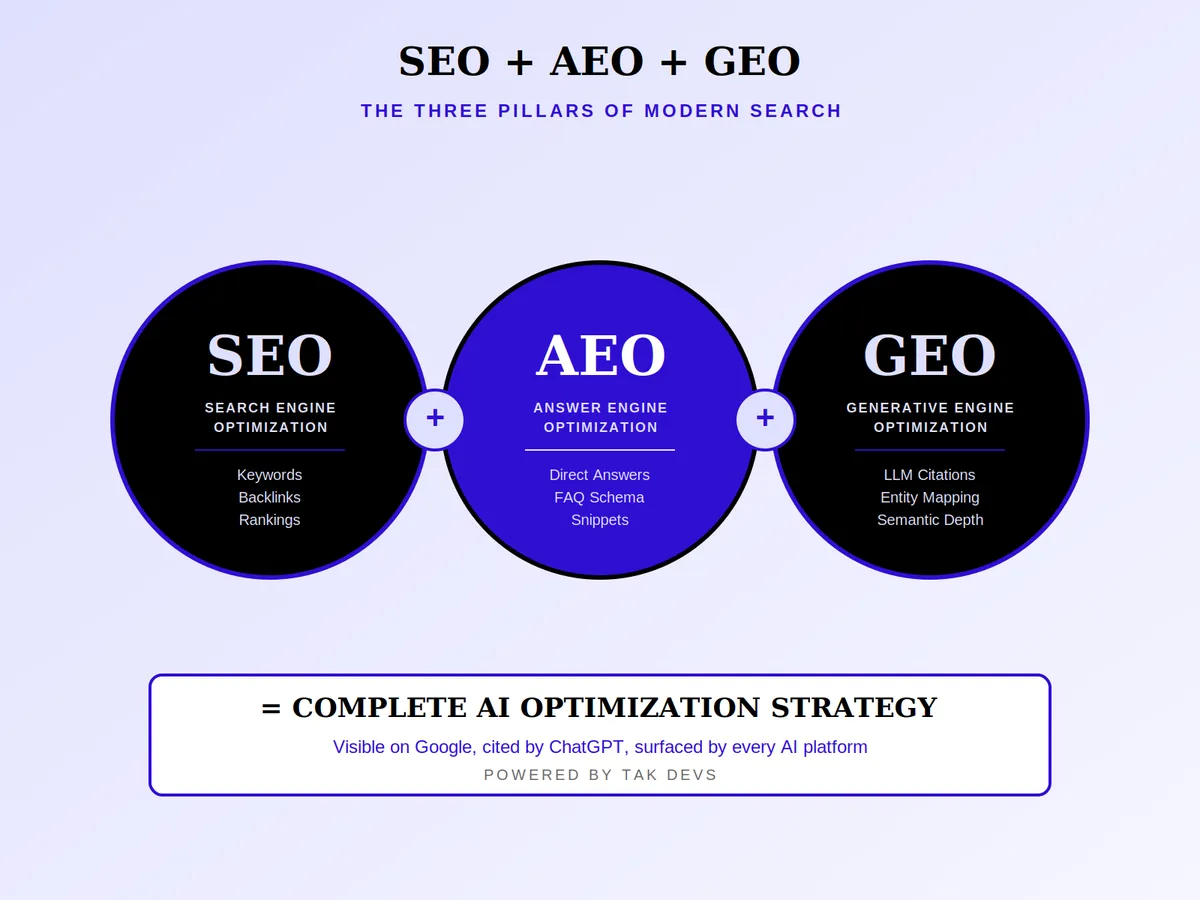
Modern AI optimization sits on three interlocking disciplines. Most agencies focus on one. Few execute all three together.
The three pillars that define a complete AI optimization strategy:
- SEO (Search Engine Optimization). The foundation. Technical health, crawlability, keyword relevance, and authoritative backlinks. This is what gets your page indexed and ranked in classic search.
- AEO (Answer Engine Optimization). Formatting content so AI answer engines can extract direct answers. This means concise definitions near headings, FAQ schema, question-based subheaders, and TL;DR summaries that answer the query in under fifty words.
- GEO (Generative Engine Optimization). The newest layer. GEO targets how large language models choose which sources to cite. It relies on entity precision, topical authority, original data, and content that reads naturally enough for LLMs to quote without paraphrasing.
When all three pillars work together, your content earns visibility across Google's traditional results, Google AI Mode summaries, ChatGPT citations, Perplexity answers, and voice assistant responses. That's the full coverage we build for at Tak Devs.
What Does AI Optimization Actually Involve?
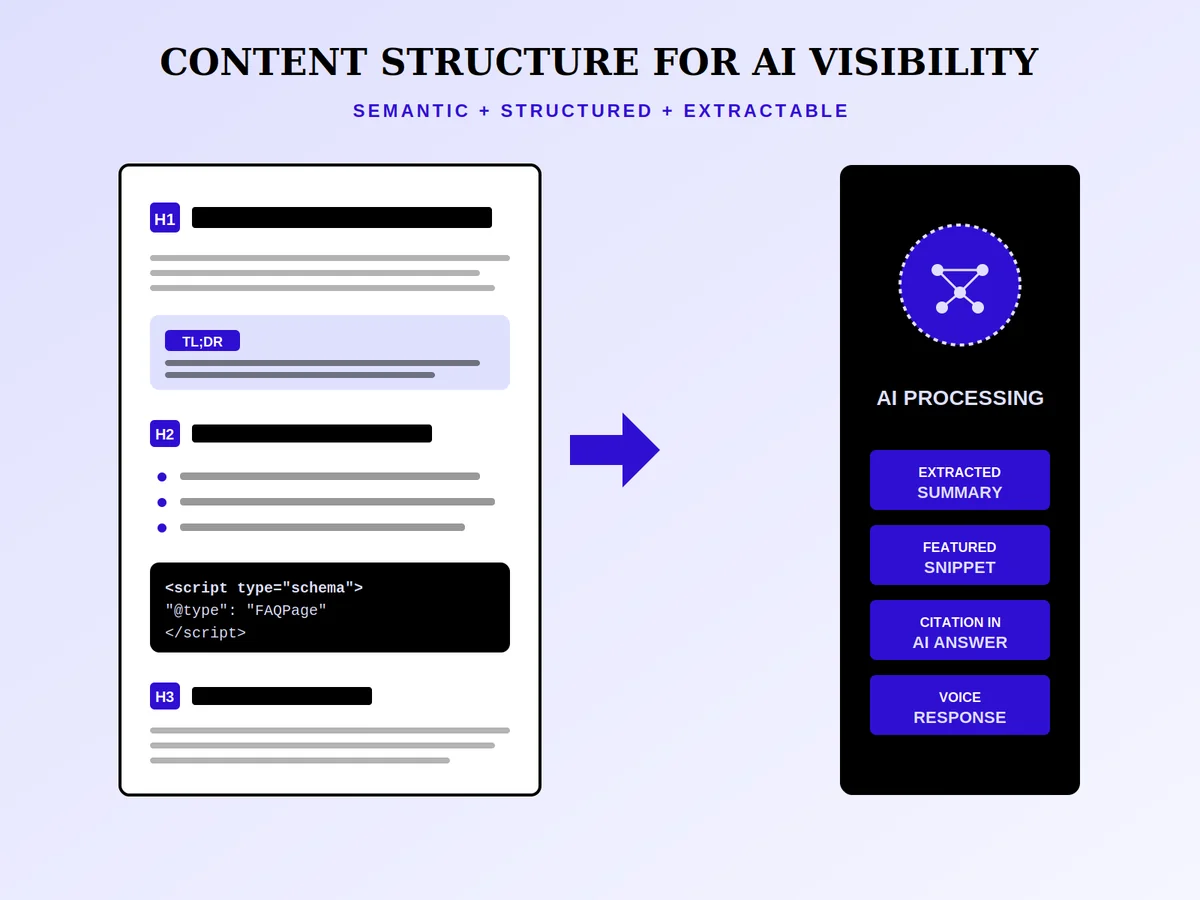
Effective AI optimization isn't one tactic, it's a connected set of changes across content, structure, and data signals. Here's what a complete service typically covers.
The five core components that turn a regular page into AI-citable content:
- 1. Content Architecture and Semantic Structuring. AI systems read content the way a teacher reads an essay. They look for a clear thesis, supporting evidence, and logical flow. We build in clean H1 to H3 hierarchy, direct answers within the first 100 words of each section, modular content blocks (definition, example, comparison, summary), and strategic bullet lists for scannable, extractable information.
- 2. Schema Markup and Structured Data. Schema.org markup is the language that tells AI what your content is about. We deploy FAQPage schema for voice-friendly question-answer blocks, Article and Person schema to signal authorship, Product and Service schema for commercial pages, and Organization schema to anchor your brand as an entity AI recognizes.
- 3. Natural Language Processing (NLP) Alignment. AI tools are built on the same NLP foundations that power large language models. Content needs to reflect how people actually speak. That includes using semantic variations naturally (vehicle, car, automobile), structuring sentences in predictable token patterns, and including the specific entities that anchor your topic.
- 4. Entity Optimization and Topical Authority. AI doesn't just read pages. It builds a knowledge graph about your brand. If your site consistently covers a tight cluster of related topics with depth and accuracy, AI systems start treating you as an authoritative source on that cluster. This is why pillar pages and topic hubs outperform isolated blog posts.
- 5. AI-Friendly Meta Content and Snippets. Beyond the body content, AI-optimized pages include TL;DR summaries near the top of long articles, featured-snippet-style answers under question headings, concise meta descriptions written like microsummaries, and well-formatted FAQ sections that answer real questions in real language.
Planning an AI Optimization Strategy for Your Business?
Tak Devs builds AI-ready, schema-rich, citation-optimized content frameworks for SaaS, finance, healthcare, e-commerce, and B2B brands. Explore how our enterprise solutions map to your visibility and growth goals.
Content Types That Benefit Most From AI Optimization
Some formats are naturally suited to AI extraction. If you're prioritizing where to invest first, start here.
The content types where we see the most consistent AI citation pickup:
- Product and service pages targeting high-intent commercial queries. Clear value propositions, comparison tables, and FAQs get lifted directly into AI-generated buying guides.
- Long-form pillar content covering a topic in depth. AI tools love comprehensive resources they can pull multiple answers from.
- Thought leadership and Q&A-style posts. Question-and-answer structure mirrors how users actually talk to AI assistants.
- Listicles and how-to guides. Structured, step-by-step content is the easiest format for AI to parse and cite.
- Comparison and review content. AI loves to summarize trade-offs, and well-built comparison pages get cited constantly.
Why Tak Devs for AI Optimization Services
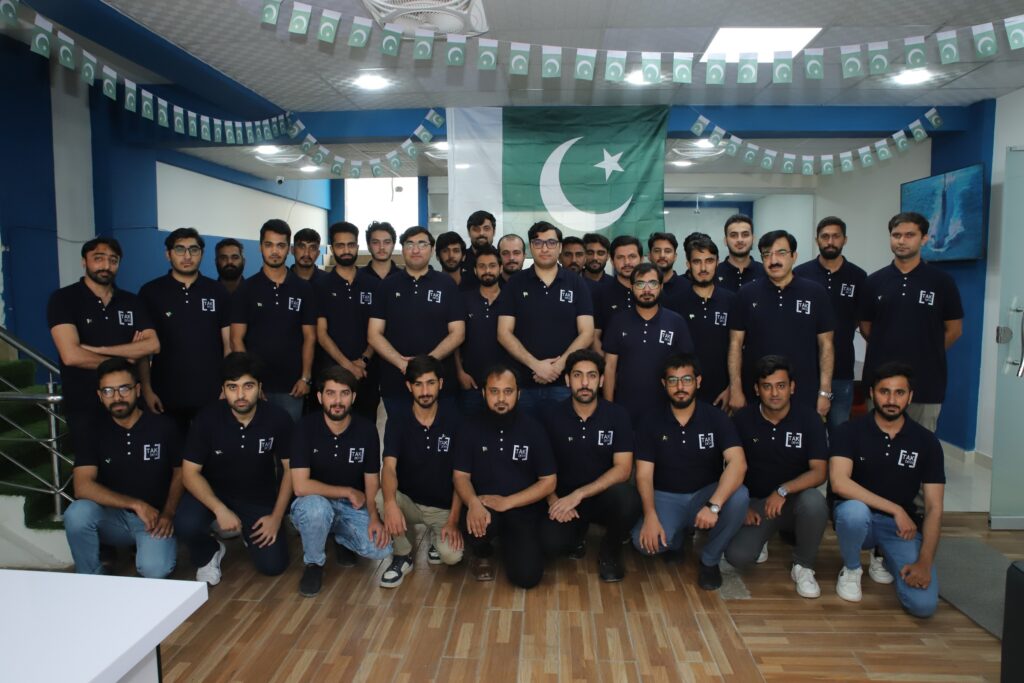
AI optimization isn't a marketing trend we picked up six months ago. Tak Devs has been building data-driven, schema-aware, semantically structured content frameworks for years. Our team combines SEO strategists, technical developers, and AI engineers under one roof, which matters when AI optimization touches everything from on-page content to backend schema deployment.
What separates our approach:
- Technical depth. We don't just rewrite content. We build the underlying schema, structured data, and site architecture that AI systems actually parse.
- Custom AI development experience. Through our Custom AI Development Services, we work directly with LLMs daily. We know what they extract because we've built systems that do the extracting.
- Full-stack optimization. From content strategy and Pay-Per-Click coordination to technical implementation and reporting, we handle the whole pipeline.
- Transparent measurement. We track citation pickup in AI platforms, not just keyword rankings. You'll see exactly where your brand surfaces and where it doesn't.
- Industry-specific expertise. SaaS, finance, healthcare, e-commerce, and B2B services each have different AI optimization patterns. We tailor strategy to your vertical.
What Results Can You Expect?
AI optimization is a compounding strategy, not an overnight switch. Most clients see meaningful movement in three to six months, with stronger results at six to nine months as AI systems re-index and rebuild their knowledge graphs around your improved content.
Typical outcomes across Tak Devs AI optimization engagements:
| Business Objective | Measurable Outcome |
|---|---|
| AI search visibility | Citations in AI Overviews and ChatGPT responses |
| Click-through performance | Higher CTR on snippet-rich, FAQ-formatted results |
| Semantic coverage | Rankings for long-tail conversational queries |
| Brand entity recognition | AI tools associate your brand with target topics |
| Future-proofing | Sustained visibility as AI search dominance grows |
| Compounding returns | Pages cited once tend to be cited again for related queries |
When Should You Invest in AI Optimization Services?
AI optimization helps almost every site, but it becomes urgent in specific situations.
The scenarios where investing now delivers the strongest return:
- Your content ranks but doesn't get cited. If you're on page one but never appear in AI Overviews, your content needs structural and semantic upgrades.
- Your traffic dropped after an algorithm shift. Google AI Mode and the late-2025 helpful content updates hit unoptimized pages hard. AI optimization can recover lost visibility.
- You're entering a competitive vertical. Finance, SaaS, health, and legal verticals are all reshaping around AI search. Being early matters.
- You're launching a new product or brand. Building AI optimization into the launch beats retrofitting it six months later.
- You want to maximize your existing content ROI. Rather than producing more, optimizing what you already have for AI extraction often yields faster gains.
How to Get Started With AI Optimization
If you're considering AI optimization services, here's the sequence that typically works best.
The six-step roadmap Tak Devs follows for AI optimization engagements:
- 1. Run an AI visibility audit. Check how often your brand appears in ChatGPT, Perplexity, and Google AI Mode for your target queries.
- 2. Identify your top 20 commercial pages. These are the pages that drive revenue. Optimize them first.
- 3. Deploy foundational schema. FAQPage, Organization, Article, and Product schema at minimum.
- 4. Restructure content for extractability. Direct answers near headings, clear hierarchy, modular blocks.
- 5. Build topical clusters. Pillar pages with supporting content that reinforces entity authority.
- 6. Measure citation pickup. Track where your content surfaces across AI platforms over time.
You can run the first two steps yourself with the right tools. Steps three through six are where most teams benefit from partnering with a specialist. That's where Tak Devs comes in.
The Bottom Line
AI optimization services aren't optional anymore. They're the new baseline for staying visible in a search landscape that's reorganizing around AI-generated answers. Whether your goal is to recover lost traffic, prepare for a product launch, or simply future-proof a brand that took years to build, the right AI optimization partner can help you get there faster.
At Tak Devs, we treat AI optimization as a long-term strategy, not a one-time project. The brands we work with don't just want to rank, they want to be the source AI tools quote when their customers ask the questions that matter. If that's what you're after too, explore the full Tak Devs solutions portfolio to see where your program fits.
Frequently Asked Questions
The questions below reflect the real concerns marketing and growth teams face when planning an AI optimization program.
AI optimization services prepare your content to be understood, summarized, and cited by AI platforms like ChatGPT, Google AI Mode, Perplexity, and voice assistants. Regular SEO focuses on ranking in traditional search results. AI optimization adds semantic structuring, schema markup, entity optimization, and conversational formatting so AI systems can extract direct answers from your content. The two work together, AI optimization isn't a replacement for SEO, it's an evolution of it.
Yes. Google AI Mode pulls from well-structured, semantically rich content with clear answer blocks. AI-optimized pages use the formatting AI Mode prefers: question-based headings, concise direct answers, FAQ schema, comparison tables, and TL;DR summaries. This significantly increases the likelihood your content gets surfaced inside AI-generated panels.
It can improve your odds substantially. ChatGPT and other LLMs cite content that's well-structured, factually clear, semantically rich, and topically authoritative. AI optimization addresses each of those signals. You won't be cited every time, no one is, but optimized pages get pulled into LLM responses far more often than unoptimized ones.
Most Tak Devs clients see early movement within 8 to 12 weeks, with stronger results at the 4 to 6 month mark. AI systems re-index and rebuild knowledge graphs on different cycles than Google's classic index, so visibility can appear in ChatGPT or Perplexity before showing up in Google AI Mode, or vice versa. Consistent measurement matters.
SEO is the foundation: technical health, keywords, links, rankings. AEO (Answer Engine Optimization) targets direct-answer extraction by formatting content as questions and concise answers. GEO (Generative Engine Optimization) targets citation pickup by large language models like ChatGPT and Claude through entity precision, semantic depth, and original data. A complete AI optimization service combines all three.
Probably yes, and here's why. Even if you rank well today, AI-generated answers are pulling clicks away from traditional results. Studies in early 2026 show click-through rates on position one have dropped 25 to 35 percent on queries with AI summaries. If your competitors get cited in those summaries and you don't, you lose visibility regardless of your rank. AI optimization protects the value you've already built.
Cost varies based on site size, content volume, and scope. A focused engagement on 20 to 30 priority pages typically runs in the low to mid four figures monthly. Full-site programs with technical implementation, ongoing content optimization, and citation tracking range higher. Tak Devs scopes engagements to budget and priority pages, so smaller businesses can start lean and scale up. The free consultation gives you a precise estimate based on your situation.
Yes, and it's especially valuable for both. Local businesses benefit from voice search optimization and AI assistant pickup ("find a plumber near me"). E-commerce sites benefit massively from product schema, comparison content, and FAQ-style buying guides that AI shopping tools surface. Many AI search interfaces are already routing commercial queries to optimized product pages.
Treating it like keyword stuffing for a new audience. AI systems are trained to detect low-quality, mass-produced content and they actively de-prioritize it. The brands that win are the ones investing in genuinely useful, well-structured, expertly written content backed by real data and experience. Shortcuts get filtered out faster than ever.
We track citation pickup across AI platforms (ChatGPT, Perplexity, Google AI Mode, Gemini), traditional ranking shifts, organic traffic from AI-influenced queries, click-through rates on snippet-rich results, and entity recognition signals. We share monthly reports so you can see exactly where your content surfaces and how visibility evolves over time. No vanity metrics, only measurable impact.
Ready to Make Your Content AI-Visible?
Talk to the Tak Devs team about a free 30-minute AI visibility consultation. We will walk you through your current AI footprint and identify the highest-impact next steps for your business.
Schedule a Consultation