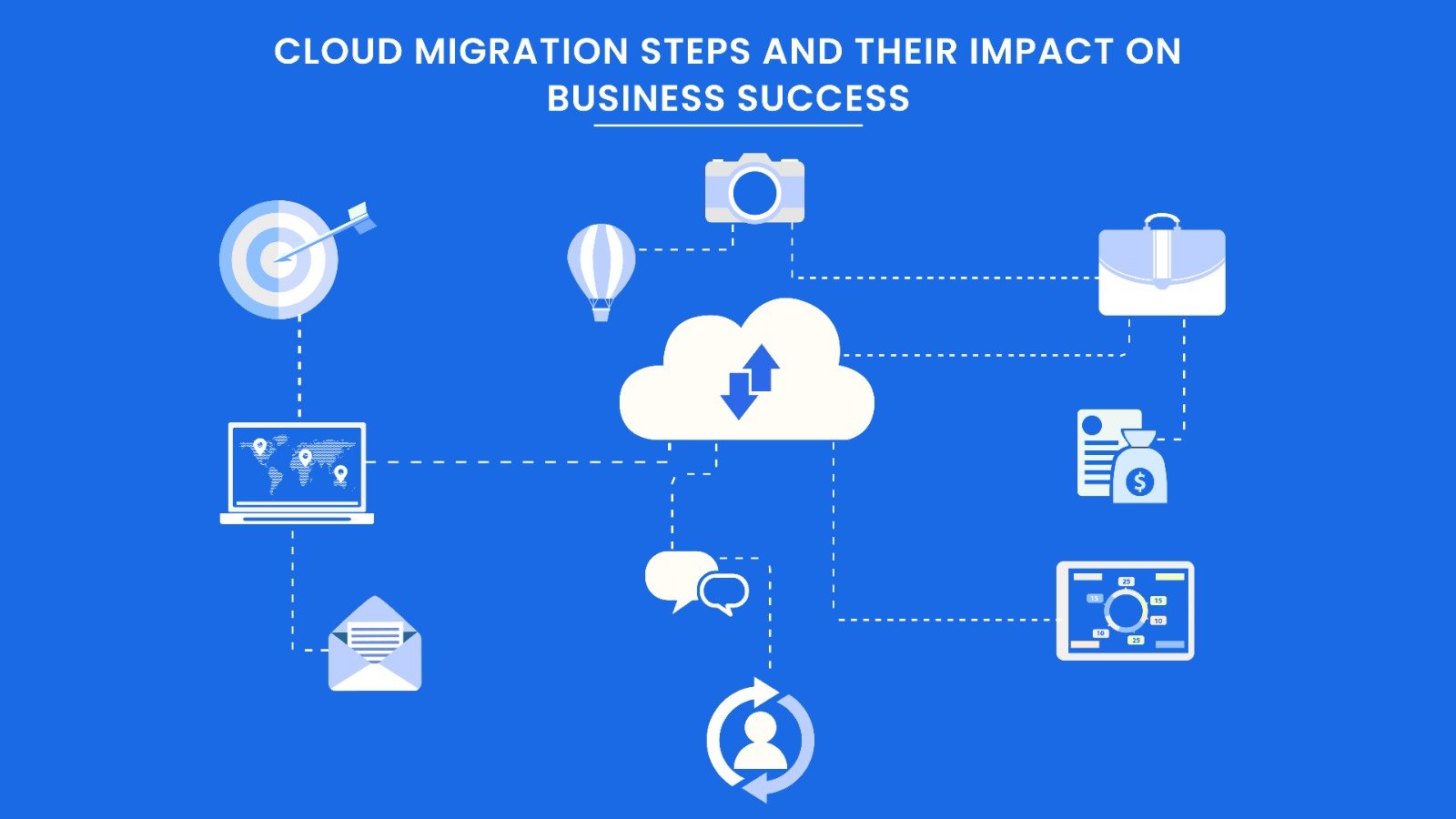
Cloud Migration Steps at a Glance
Moving to the cloud is no longer just an IT decision. Cloud migration today defines how smoothly an organisation shifts from on-premise systems to a modern and scalable environment. When these steps are planned with care, businesses gain far better performance and long-term cost control.
Why Cloud Migration Is a Business Priority, Not Just an IT Move

Cloud migration means moving digital assets like applications, data, and systems from on-premise infrastructure to a cloud environment. It is not a technical shift — it is a business decision that directly affects how a company operates, grows, and competes.
For many businesses, the move is driven by more than just cost or convenience. It is about gaining the flexibility to scale quickly, support remote teams, improve customer experience, and reduce reliance on outdated hardware.
Key reasons businesses choose to migrate to the cloud:
- Faster access to resources and infrastructure without upfront capital expenditure
- Lower maintenance and operational costs over the long term
- Reduce performance and uptime for critical apps through cloud-native resilience
- Easier global access for remote teams and distributed workforces
- Better foundation for analytics, AI, and automation at scale
Cloud adoption has grown from a trend into a necessity. Whether you are a startup or an enterprise, staying competitive means having systems that are agile, secure, and ready to support what cloud migration is the path to achieving those goals.
Building a Cloud Migration Roadmap That Actually Works

A well-structured cloud migration roadmap keeps the process focused and aligned with business goals. Without one, teams often run into delays, unexpected costs, or technical failures mid-migration.
Use these five clear steps to build a roadmap that works in the real world.
Define Your Business Goals
Start by identifying what success looks like. Define clear, measurable goals and choose the right migration tools. Modernise visibility, Modernise outdated systems. Let these goals guide your decision from start to finish.
- Define measurable outcomes: Are you targeting cost reduction, performance improvement, or better scalability?
- Align IT with business priorities: Every migration decision should connect back to a business objective.
- Set KPIs upfront: Establish the metrics you will use to measure success post-migration.
Map Your Current Environment
Take stock of your existing apps, data, and infrastructure. This gives you visibility into what must be migrated, what can be retired, and what needs rework.
- Application inventory: Document every application, its dependencies, and its current performance status.
- Data mapping: Identify where data lives, how it flows, and what compliance requirements apply to it.
- Infrastructure dependencies: Flag any tightly coupled systems that need special handling during migration.
Identify Risks
Anticipate the complexity gaps. Add buffer steps so your team is not caught off guard mid-migration.
- Security and compliance risks: Identify data that requires special handling under GDPR, HIPAA, or other regulations.
- Legacy compatibility: Some older systems may not migrate cleanly — plan for refactoring or replacement.
- Downtime windows: Calculate acceptable downtime and build contingency plans for critical systems.
Break It Into Phases
Avoid doing everything at once. Use more core systems at first. Move to more complex ones later. Move more systems at this time systematically proven.
- Start with low-risk workloads: Non-critical systems and development environments are ideal for early migration waves.
- Use phased milestones: Define clear gates between phases with validation criteria before proceeding.
- Validate before moving forward: Confirm stability and performance at each phase before beginning the next.
Plan for After the Move
Invest in tooling for testing, monitoring, and ongoing optimisation to make the new setup perform better than the old one. It is the link between strategy and execution. Without a well-funded migration plan, even the strongest strategy can fall short.
- Monitoring and observability: Set up cloud-native monitoring tools before go-live, not after problems appear.
- Cost optimisation plan: Cloud spend can balloon quickly without governance — establish budget alerts and right-sizing processes.
- Team training: Ensure your internal team is prepared to operate and iterate in the new cloud environment.
Choosing the Right Cloud Migration Strategy for Your Business

Not all migrations follow the same path. The right cloud migration strategy depends on your systems, goals, timelines, and resources. This is where many businesses get it wrong.
Before you choose, take a step back and revisit your cloud migration planning. Are you migrating a few apps or your entire infrastructure? Do you need to modernise or simply relocate?
There are four common strategies to consider:
| Strategy | Best For | Key Consideration |
|---|---|---|
| Rehost (Lift & Shift) | Often called lift and shift. Fastest to deploy but limited in long-term cloud benefits | Minimal re-architecting; best for quick wins |
| Replatform | Redeploying the application to run on cloud optimisation without full re-architecture | A balance between speed and optimisation |
| Refactor / Re-architect | Moving the application to run in modern SaaS-based services | Highest long-term value; most complex |
| Replace | Moves from legacy to modern SaaS-based services | Good for outdated or unsupported systems |
Each strategy has trade-offs. The goal is to pick the best one that works for your team, your budget, and your future roadmap.
Tools That Support a Smooth Cloud Migration
Planning is essential, but execution is where many migrations hit friction. This is where the right cloud migration tools can save time, reduce errors, and simplify complex tasks like data replication, testing, or spinning up environments.
Larger enterprises may need automation platforms for orchestration. Smaller teams may rely on more lightweight services. Either way, the goal is to reduce manual work and increase visibility across every stage.
Common types of migration tools include:
- Assessment tools to scan your current environment and generate migration-readiness reports
- Data migration services to transfer databases with minimal downtime and data integrity guarantees
- Testing and validation tools to check performance post-migration before full go-live
- Monitoring tools to track issues during and after migration in real time
No tool replaces strategy or planning. But with the right mix of automation and oversight, these tools make the process faster, safer, and far less stressful.
What to Focus on After the Migration Is Complete

Many teams breathe a sigh of relief once everything is done. But this is rarely a fresh line — the post-migration phase is where long-term success is shaped.
Right after the move, close all systems running as expected. Are all systems running as expected? Are users able to access what they need, to data flowing correctly. From there, shift your priorities to the following post-migration practices:
- Monitor system performance continuously using cloud-native observability tools
- Manage and optimise cloud costs by right-sizing resources and eliminating idle services
- Review user access and security policies now that infrastructure has changed
- Decommission and address unused services that were migrated but no longer needed
- Document the new cloud architecture for internal knowledge transfer and future planning
Post-migration work just got maintenance. It is where you turn the move into real business value. The better you manage this phase, the more return you get from your investment.
Need Expert Help With Your Cloud Migration?
Even with the right roadmap, tools, and internal planning, some migrations demand outside expertise. If your team is short on time or facing complex technical challenges, working with a professional cloud migration services provider can save weeks of guesswork and reduce risk.
Whether you have a few applications or your full infrastructure, a trusted team can guide you through assessment, migration, and post-migration stabilisation. This ensures you move to the cloud at the right pace, securely and with minimum business disruption.
Explore professional cloud services from TAK Devs to get hands-on support tailored to your needs. Their experts help businesses streamline migration, minimise risk, and unlock the full benefits of cloud infrastructure.
End-to-End Cloud Migration Services Built Around Your Business Goals.
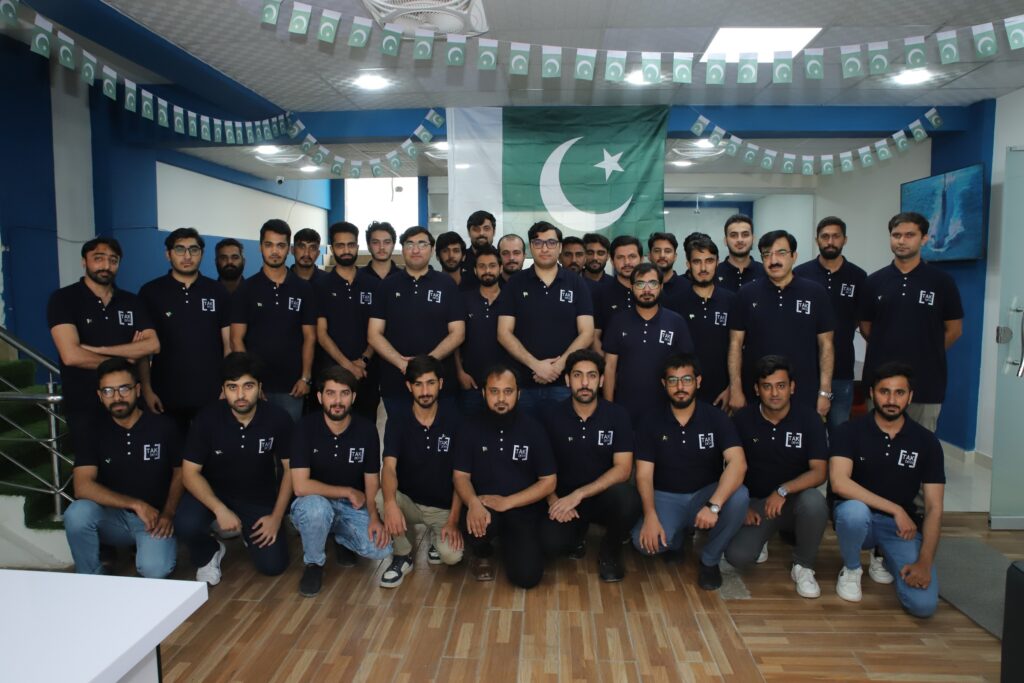
TAK Devs brings together deep cloud expertise, a structured migration methodology, and hands-on delivery to guide businesses from legacy infrastructure to scalable cloud environments. Whether you are migrating a single application or your entire stack, the team handles assessment, execution, and post-launch optimisation with full transparency at every step.
TAK Devs works with businesses at every stage — from initial planning through long-term cloud management — ensuring that every migration decision is made with your business outcomes in mind.
Frequently Asked Questions
The questions below address the most common concerns businesses have when planning and executing a cloud migration.
Cloud migration is the process of moving digital assets — including applications, data, and infrastructure — from on-premise or legacy environments to a cloud-based platform. It matters because it directly impacts how quickly a business can scale, how securely it can operate, and how cost-efficiently it can manage its IT resources. Done well, it gives organisations the agility to compete in fast-moving markets.
The timeline varies considerably based on the scope and complexity of the migration. A focused application migration might take four to eight weeks. A full infrastructure migration involving multiple systems, compliance requirements, and data volumes can take six to eighteen months. Phased approaches that break the migration into waves typically reduce risk and keep timelines more predictable.
The most common risks include data loss or corruption during transfer, unexpected downtime for critical systems, cost overruns from unoptimised cloud resources, and security vulnerabilities introduced during the transition. These are best avoided through thorough upfront assessment, a phased migration approach, rigorous testing before go-live, and clear rollback plans for each migration wave.
Rehosting, or lift-and-shift, moves applications to the cloud with minimal changes. It is the fastest option but does not leverage cloud-native capabilities. Replatforming makes modest optimisations during the move, such as switching to a managed database service, without fully redesigning the application. Refactoring involves re-architecting the application to fully exploit cloud-native features, which takes more time but delivers the greatest long-term performance and cost benefits.
Cloud cost management requires ongoing attention. Start by right-sizing resources to match actual usage rather than peak projections. Set up budget alerts and spending thresholds through your cloud provider's cost management tools. Regularly audit for idle resources, unused storage, and over-provisioned instances. Tagging resources by project, team, or environment makes it much easier to identify where spend is going and where it can be reduced.
Yes, absolutely. Cloud migration is not exclusive to enterprise organisations. Many cloud providers offer flexible pricing models and managed services specifically suited to smaller teams. The key for smaller businesses is prioritising which workloads to migrate first, choosing an engagement model that fits the budget, and partnering with an experienced provider who can guide the process without requiring a large internal IT function.
Data security during migration requires encryption in transit and at rest, strict access controls throughout the migration process, and compliance validation at each stage. All team members with access to sensitive data during the migration should be operating under a clearly defined access policy. Post-migration, access privileges should be reviewed and tightened to reflect the new cloud environment rather than carried over wholesale from the legacy setup.
A solid cloud migration plan should include a full inventory of current systems and their dependencies, clearly defined business goals, a chosen migration strategy for each workload, a phased migration schedule with milestones, a risk register with mitigation plans, testing and validation criteria for each phase, a rollback procedure for critical systems, and a post-migration monitoring and optimisation plan. Without these elements, even well-resourced migrations tend to run into avoidable problems.
Final Thoughts on Cloud Migration
Cloud migration is more than a technical upgrade. It is a shift in how your business operates, scales, and competes. With the right planning, tools, and strategy, it becomes an opportunity to simplify systems, reduce costs, and build a more resilient future.
The key to success is approaching each step with intention — not just moving infrastructure from one location to another, but using the process to modernise, optimise, and set your operations up for long-term advantage.
TAK Devs is ready to support your migration journey from the first planning session through to post-launch optimisation. Explore TAK Devs' full range of cloud and software solutions to see where they can make the biggest difference for your business.
Ready to Start Your Cloud Migration?
Schedule a free discovery call with the TAK Devs team. We will assess your current environment, help you define the right migration strategy, and map out a clear path to the cloud.
Schedule a Consultation