Custom Energy Management Software at a Glance
Energy is no longer a back-office expense. It is a board-level metric tied to sustainability targets, regulatory exposure, and operating margins. The organizations that manage it best are the ones that stop relying on generic dashboards and start investing in custom energy management software development built around their actual assets, data, and compliance environment.
Quick Answer: What Is Custom Energy Management Software Development?
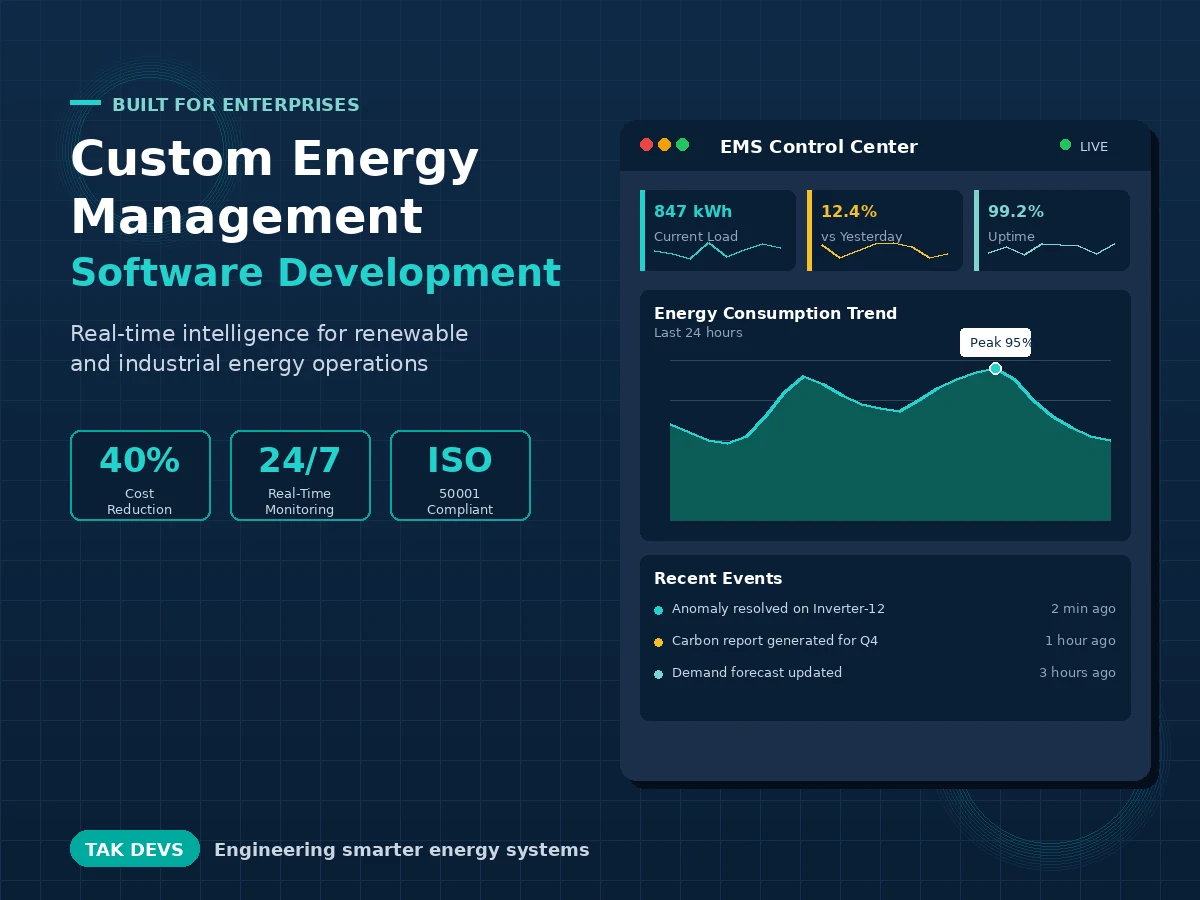
This guide walks through how custom EMS platforms are designed, what they include, how they outperform off-the-shelf tools in real deployments, and what the build process looks like when you partner with an engineering team like TAK Devs.
Custom energy management software development is the process of designing, building, and integrating a tailored digital platform that monitors, analyzes, and optimizes how an organization consumes and produces energy across its assets, sites, and supply chain.
Unlike packaged EMS products, a custom build is engineered around the client's meters, sensors, control systems, ERP, and reporting frameworks (ISO 50001, ESG disclosures, regional grid codes). It typically combines IoT data ingestion, AI-driven analytics, role-based dashboards, automated reporting, and deep integration with operational systems so a single platform replaces a stack of disconnected tools.
Why Off-the-Shelf EMS Tools Fall Short for Mature Operations
Packaged EMS platforms are excellent for small sites and standardized use cases. They struggle the moment a business has any of the following: multiple sites, mixed-vintage equipment, hybrid renewable and grid supply, region-specific compliance, or its own data lake.
The common failure points we see when teams switch from packaged tools to a custom EMS build:
- Data fragmentation. Off-the-shelf dashboards rarely connect to legacy SCADA, building management systems, and modern IoT sensors simultaneously. Teams end up exporting CSVs and reconciling numbers in spreadsheets.
- Reporting gaps. Generic templates do not map cleanly to ISO 50001 energy reviews, GRI disclosures, or local utility filings. Manual rework is constant.
- Vendor lock-in. New asset types, new tariffs, or new business units often require a roadmap request that may or may not get built.
- Limited intelligence. Static thresholds and rule-based alerts cannot model the load patterns of facilities that mix solar generation, battery storage, and variable production schedules.
A custom platform removes those ceilings. It is sized to the scale of the operation, structured around its data, and aligned with the compliance landscape it actually faces.
Custom EMS vs Off-the-Shelf EMS: A Practical Comparison
The decision is rarely "custom or nothing." It is about matching the tool to the complexity of the operation.
The table below captures how the two approaches diverge across the criteria that matter most for enterprise buyers.
| Criteria | Off-the-Shelf EMS | Custom EMS (TAK Devs Built) |
|---|---|---|
| Flexibility | Fixed feature set, limited configuration | Modules engineered around actual workflows and KPIs |
| Integration | Pre-built plug-ins, limited to vendor catalog | Native APIs into ERP, SCADA, CMMS, billing, and data lakes |
| Scalability | Tied to vendor roadmap and license tiers | Modular architecture that scales with sites and assets |
| Total Cost | Lower upfront, recurring license costs grow with scale | Higher upfront, lower long-term cost and full IP ownership |
| Compliance Fit | Generic templates, partial regional support | Aligned to ISO 50001, ESG, and local grid standards by design |
| Data Ownership | Hosted in vendor cloud, limited export options | Full ownership, choice of hosting (cloud, hybrid, on-prem) |
| AI & Analytics | Pre-set rules and basic forecasting | Domain-trained models tuned to your load profile |
How Custom Energy Management Software Works
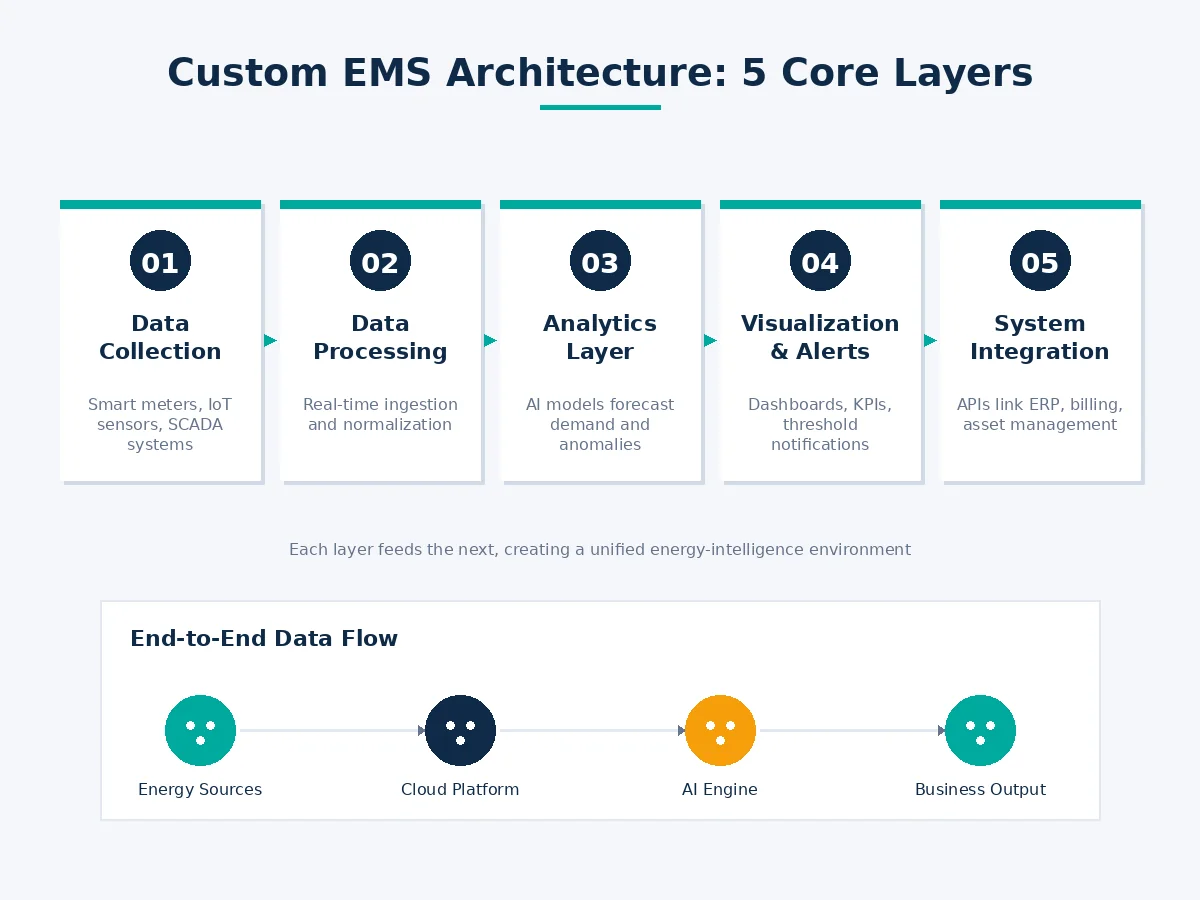
A well-designed EMS is not a single product. It is a layered system where each layer feeds the next, turning raw meter readings into operational and financial decisions.
The five-layer reference architecture used in custom EMS builds:
- 1. Data Collection. Readings flow in from smart meters, IoT sensors, SCADA systems, inverters, and BMS controllers. Where field devices are old, we add edge gateways that translate legacy protocols (Modbus, BACnet, DNP3) into modern message formats.
- 2. Data Processing. An ingestion pipeline cleans, normalizes, and timestamps every reading. This stage handles missing values, unit conversions, and time-zone alignment so downstream analytics work on a single trustworthy dataset.
- 3. Analytics Layer. Machine learning models forecast demand, flag anomalies, and benchmark performance against historical baselines. Forecasts feed load balancing, while anomaly detection drives the alert engine.
- 4. Visualization and Alerts. Role-based dashboards expose the right KPIs to operations, finance, and sustainability teams. Threshold breaches trigger notifications via email, SMS, Slack, or Microsoft Teams depending on severity.
- 5. System Integration. The EMS connects through APIs to ERP, billing, CMMS, and asset management tools so consumption data flows into invoicing, maintenance scheduling, and financial reporting without manual handoffs.
Core Features That Define a Strong Custom EMS
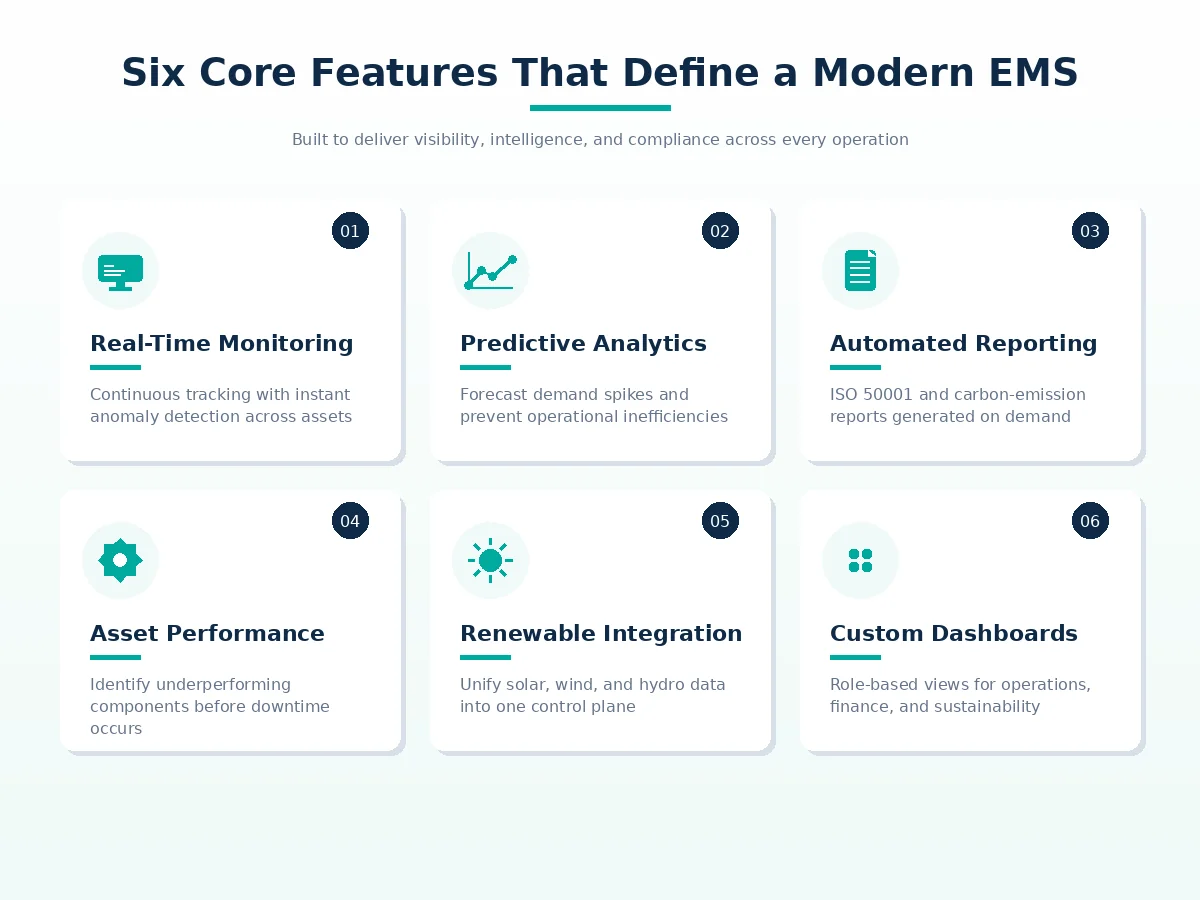
Across the deployments TAK Devs has delivered, the same set of features keeps surfacing as the difference between a dashboard and a true decision system.
The six feature pillars that consistently deliver measurable ROI:
- Real-Time Energy Monitoring. Continuous tracking at minute or sub-minute resolution exposes load spikes the moment they happen. In one TAK Devs deployment for a multi-site manufacturer, this caught a faulty compressor that was adding roughly 8% to the monthly bill before maintenance had any record of an issue.
- Predictive Analytics. Forecasting demand curves 24 to 72 hours ahead lets operations teams shift discretionary loads, charge batteries during off-peak windows, and pre-empt demand-charge penalties.
- Automated Compliance Reporting. ISO 50001 energy reviews, carbon disclosure submissions, and utility filings are generated from the same dataset. The reporting module replaces what used to be a multi-week manual exercise with a scheduled job.
- Asset Performance Tracking. Each major asset (chiller, inverter, motor) has a digital baseline. Drift from that baseline triggers an investigation before the asset fails, reducing downtime and stretching capital cycles.
- Renewable Integration. Solar arrays, wind assets, and storage systems show up alongside grid consumption in a single view, with clear visibility into self-consumption ratios, export revenue, and curtailment events.
- Custom Dashboards. A plant manager, a CFO, and a sustainability lead need different views of the same data. The dashboard layer ships with role-based templates and a drag-and-drop builder for new ones.
Planning a Custom EMS for Your Operations?
TAK Devs builds ISO-aligned, AI-ready EMS platforms for renewable, industrial, and commercial portfolios. Explore how our enterprise software solutions map to your energy and sustainability roadmap.
Which Industries Benefit Most from Custom EMS Development
Custom EMS engagements deliver the strongest ROI when energy is a material cost line and operations are too complex for templated tools.
The sectors where we see the most consistent value:
- Renewable energy operators managing distributed solar, wind, or hybrid portfolios across multiple sites.
- Manufacturing and heavy industry with significant process loads, demand-charge exposure, and ISO 50001 obligations.
- Commercial real estate and data centers tracking PUE, cooling efficiency, and tenant-level chargebacks.
- Utilities and grid operators that need to model demand response, distributed energy resources, and peak shaving.
- Healthcare and pharma campuses where uptime, compliance, and energy intensity all share the same critical infrastructure.
The TAK Devs Development Process
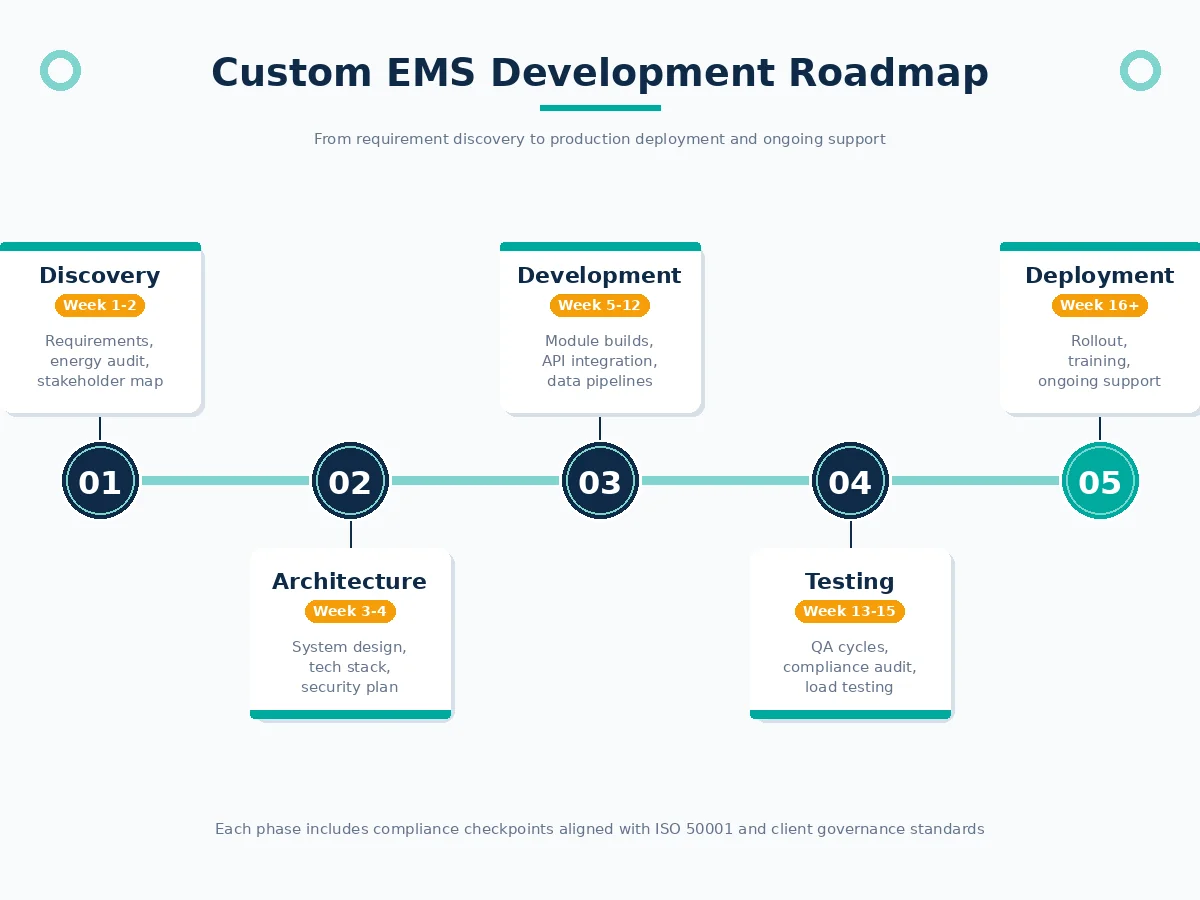
A custom EMS is a long-cycle product. The pace at which a build moves through these phases depends on the data environment, the number of sites, and the regulatory scope, but the structure of the work is consistent.
The five-phase delivery roadmap TAK Devs follows for custom EMS engagements:
- Discovery and Requirement Analysis. We start with an energy and data audit. That includes a meter inventory, an integration map of existing systems, a compliance scope review, and a stakeholder workshop to define the KPIs the platform must serve.
- Architecture and Design. Outputs include the system architecture, the data model, the API surface, the security and access framework, and the deployment topology (cloud, hybrid, on-prem). Compliance requirements are baked into the design rather than added later.
- Development and Integration. Engineering proceeds in iterative sprints. Each sprint delivers a working module (ingestion, analytics, reporting, dashboard, integration), demoed against real client data so feedback shapes the next sprint.
- Testing and Optimization. The platform goes through functional QA, load testing, security review, and a compliance audit against ISO 50001 and any client-specific governance standards. Performance is tuned before the system carries production traffic.
- Deployment and Continuous Support. Rollout is phased by site or business unit. Training, runbooks, and a managed support model follow go-live. Most clients move into a continuous improvement cadence where new sites, new tariffs, and new analytics are added on a quarterly release cycle.
Compliance and Standards a Custom EMS Must Address
Energy software lives inside a thicker compliance layer than most enterprise applications.
The frameworks that come up most often in our scoping conversations:
- ISO 50001: the international standard for energy management systems, covering policy, planning, measurement, and review.
- ISO 14001 and ISO 14064: environmental management and greenhouse gas accounting, frequently cited alongside 50001 for ESG reporting.
- Regional grid codes: safe integration of distributed generation, especially for renewable operators feeding into local utility networks.
- ESG and carbon disclosure frameworks: GRI, SASB, TCFD, and CDP, plus regional equivalents like CSRD in Europe and BRSR in India.
- Cybersecurity standards: SOC 2, ISO 27001, and IEC 62443 for industrial control system security.
The advantage of a custom build is that these frameworks become design inputs, not bolt-ons. Audit trails, retention policies, and report formats are engineered in from day one.
AI & IoT Integration in Custom EMS Platforms
The difference between a reporting dashboard and a true energy intelligence system is what happens between data collection and human action. In a custom build, that middle layer is where AI models and IoT pipelines do the heaviest work.
How AI and IoT come together inside a custom EMS:
- IoT data ingestion at scale. Smart meters, inverters, BMS controllers, and edge gateways stream readings into a unified pipeline. Custom builds support thousands of devices per site without the throttling limits packaged tools enforce.
- Demand forecasting models. Time-series models trained on the client's own load history outperform vendor-default forecasts because they learn the specific seasonality, shift patterns, and tariff structures of the operation.
- Anomaly detection. Machine learning flags drift, faulty equipment, and unusual consumption patterns long before fixed thresholds would catch them. This is what catches the failing compressor on the night shift, not the morning audit.
- Edge processing. Where bandwidth or latency is a constraint, edge devices pre-process readings on site and forward only the signals that matter to the cloud layer. This is critical for remote renewable assets and large industrial campuses.
- Closed-loop optimization. Mature deployments push AI recommendations back into operational systems: battery scheduling, load shedding, and HVAC setpoints adjust automatically based on forecast outputs, within guardrails the operations team sets.
TAK Devs treats AI and IoT as core engineering competencies rather than third-party plug-ins. Models, pipelines, and edge integrations are designed alongside the rest of the platform, which is what keeps accuracy high and integration debt low as the system scales.
Business Outcomes Clients See
Every TAK Devs EMS deployment is measured against the business objectives that justified the investment. These outcomes show up consistently across renewable, industrial, and commercial portfolios.
| Business Objective | Measurable Outcome |
|---|---|
| Operational efficiency | Automated control loops and faster incident response |
| Cost optimization | Lower demand charges and reduced waste from anomaly detection |
| Regulatory compliance | Audit-ready reports against ISO 50001 and ESG frameworks |
| Sustainability progress | Transparent Scope 1 and Scope 2 emissions tracking |
| Scalability | New sites, assets, and tariffs added without re-architecting |
| Data-driven planning | Forecast-led capex decisions instead of reactive purchases |
Why Teams Choose TAK Devs for Custom EMS Development
Custom EMS programs do not fail because the technology is wrong. They fail because the data, integration, and compliance work is underestimated. This is the gap TAK Devs was built to close.
Our engineering teams have shipped EMS modules across solar, wind, manufacturing, and commercial real estate, with AI, IoT, and compliance treated as core competencies rather than optional add-ons.
Whether your starting point is a single-site MVP or a multi-site enterprise rollout, the TAK Devs team can plug into the discovery, architecture, build, and operate phases of your custom energy management software development journey. Two-week sprints, shared backlogs, and live demo environments mean stakeholders see progress on real data throughout the build.
Explore TAK Devs SolutionsConclusion
Energy management has moved from a utility concern to a strategic capability. The organizations that treat it that way are the ones investing in custom energy management software development, because that is what makes their data, their compliance posture, and their sustainability commitments work together instead of working around each other.
A custom EMS is not the right answer for every operation. But for any business with meaningful energy spend, multiple sites, renewable assets, or a serious ESG mandate, it consistently pays back in lower bills, better audits, and faster decisions. If that describes your operation, this is the work TAK Devs is built for. Explore the full TAK Devs solutions portfolio to see where your program fits.
Frequently Asked Questions
The questions below reflect the real concerns enterprise teams face when planning a custom EMS program.
It is the engineering process of building a tailored digital platform that monitors, analyzes, and optimizes energy use across an organization's assets, sites, and supply chain. Unlike packaged tools, a custom EMS is designed around the client's specific meters, control systems, integrations, and compliance frameworks (such as ISO 50001 and regional ESG standards).
Off-the-shelf platforms offer fixed dashboards and limited integrations. A custom EMS connects natively to the systems you already run (SCADA, ERP, CMMS, IoT gateways), uses analytics tuned to your load profile, and produces reports in the exact format your auditors and regulators expect. You also own the IP and choose the hosting model.
A focused single-site MVP typically goes live in 12 to 16 weeks. Multi-site enterprise rollouts with deep ERP and SCADA integration usually take 6 to 9 months for the first major release, followed by phased site activations. TAK Devs structures every engagement to deliver working modules every two weeks so value lands before full release.
Cost depends on the number of sites, the complexity of integrations, the depth of analytics, and the compliance scope. Pilot builds for a single facility commonly fall in a five-figure range, while enterprise multi-site platforms scale into six figures. The economics typically favor custom over packaged tools once you cross three or four sites, multiple compliance frameworks, or a portfolio with renewables.
Renewable energy operators, manufacturers, commercial real estate portfolios, data centers, utilities, and healthcare or pharma campuses all see strong ROI. The common thread is meaningful energy spend, multiple sites or asset types, and regulatory or sustainability reporting obligations.
Yes. Native integration is one of the core reasons clients move from packaged tools to a custom platform. TAK Devs builds API and edge-gateway integrations into SAP, Oracle, Microsoft Dynamics, leading CMMS tools, and major SCADA platforms, plus legacy field protocols like Modbus, BACnet, and DNP3.
Outcomes vary by starting point, but typical results across TAK Devs deployments include reductions of 15 to 40% in avoidable energy waste, faster compliance reporting cycles (often from weeks to hours), measurable drops in demand-charge exposure, and clearer visibility for ESG disclosures.
Security is a design input, not a feature. TAK Devs builds EMS platforms against SOC 2, ISO 27001, and IEC 62443 controls where applicable, with role-based access, encrypted data flows, audit logging, and segregated industrial network zones for any OT integrations.
Yes. Renewable integration is one of the most common scopes we deliver. The platform unifies generation, storage, and consumption data, calculates self-consumption ratios, tracks curtailment, and feeds output forecasts into load planning and battery scheduling.
Most TAK Devs clients move into a managed evolution model: a dedicated engineering pod handles platform monitoring, incident response, security patching, and quarterly feature releases. Training, documentation, and runbooks are part of every handover.
Ready to Scope Your Custom EMS Build?
Talk to the TAK Devs engineering team about a discovery workshop. We will map your energy data, compliance scope, and integration landscape into a delivery plan you can take to your board.
Schedule a Consultation